


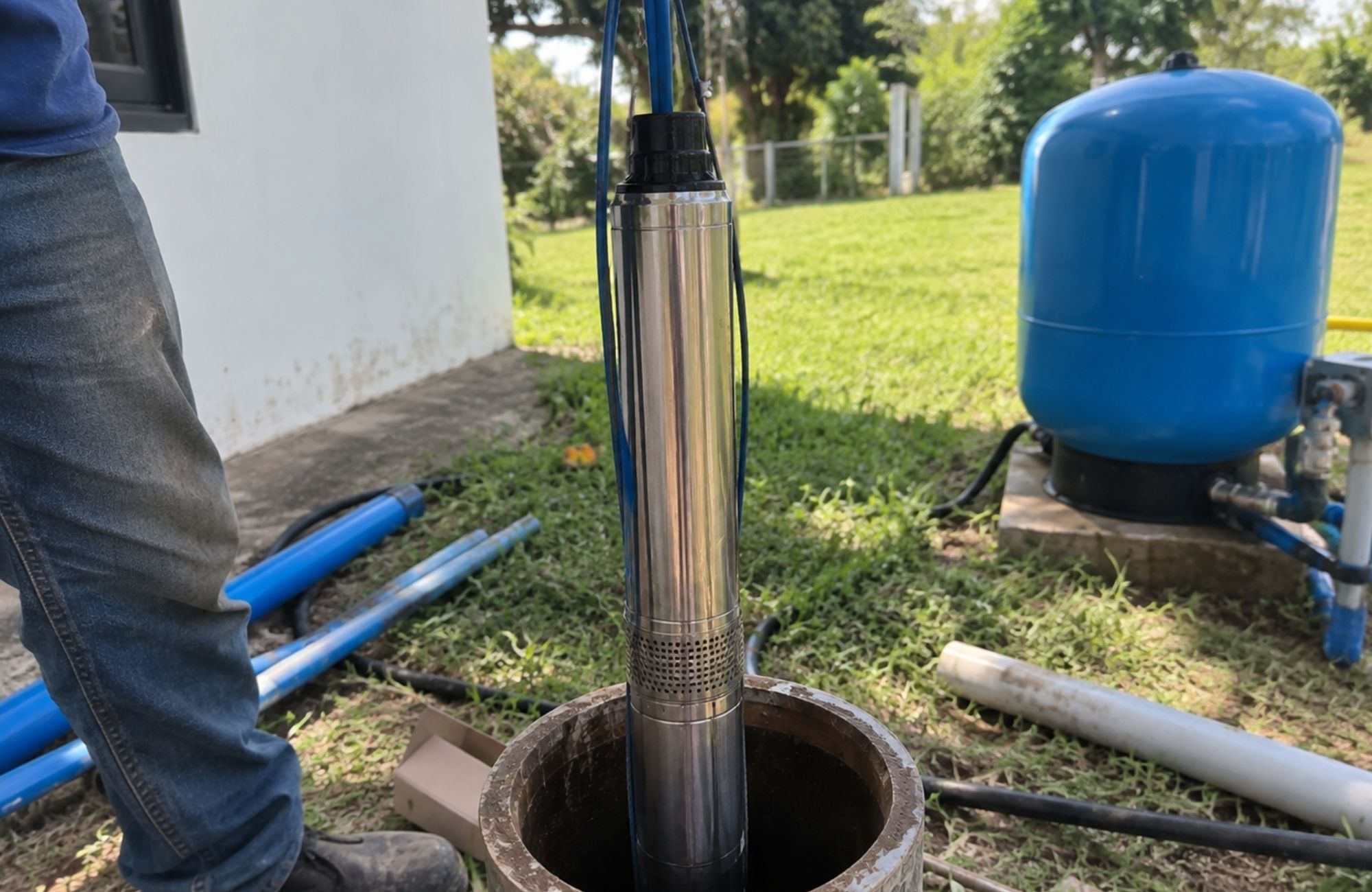
The size of a submersible pump you need depends mainly on your required flow rate in gallons per minute and the total dynamic head the pump must overcome. Well depth and horsepower are part of the decision, but neither can determine the right pump size on its own.
For Connecticut homeowners with private wells, pump selection can also depend on well yield, pumping water level, pressure settings, pipe size, casing diameter, and manufacturer performance data. These measurements help match the pump to the way the well and plumbing system actually operate.
What Size Submersible Pump Do I Need for My Well?
The right submersible well pump should deliver the required gallons per minute at the total dynamic head of your system without exceeding the amount of water the well can sustainably supply. After those values are known, the manufacturer’s pump curve can be used to identify an appropriate pump model and motor size.
Think of GPM as how much water your home needs and TDH as how much resistance the pump must overcome. A pump may deliver a high flow rate at low head but considerably less water when it has to lift from a deeper water level and maintain household pressure.
That is why a rule such as “a 300-foot well needs a 1 HP pump” can be misleading. Two wells with the same total depth can have different pumping water levels, well yields, pipe layouts, pressure settings, and household demand. A well pump installation should account for these conditions before the final pump is selected.
What Information Do You Need Before Sizing a Pump?
Before sizing a submersible pump, gather the household flow requirement, pumping water level, well yield, pressure setting, pipe size and length, casing diameter, and electrical information. These values show how much water the pump must move and how much resistance it must work against under normal operating conditions.
Some details may be available from well records, pump labels, or previous service information. Other values, especially pumping water level and current well yield, may need to be measured during a well inspection.
Key Pump-Sizing Measurements
Each sizing input answers a different part of the selection process. Using all of them produces a much better picture than choosing a pump based mainly on horsepower.
| Sizing Input | Why It Matters |
| Required flow rate (GPM) | Shows how much water the household needs during periods of higher use |
| Pumping water level | Helps determine actual vertical lift while the pump runs |
| Well yield | Shows how much water the well can sustainably supply |
| Pressure requirement | Adds head that the pump must overcome |
| Pipe length and diameter | Affect friction loss |
| Casing diameter | Determines pump and cable clearance |
| Electrical supply | Must match the motor, controls, voltage, and wiring |
Static Water Level vs. Pumping Water Level
The static water level is the level of water in the well when pumping has stopped and the well has had time to recover. It describes the resting water level.
The pumping water level, also called the dynamic water level, is the level while the pump is operating. Because water levels can fall during pumping, this measurement is usually more useful when calculating how far the pump must lift water.
A well may be 300 feet deep even though its pumping water level is much shallower. Total well depth therefore should not be treated as the same thing as pump lift.
How Much Flow Does a Home Need?
Household flow depends on factors such as the number of bathrooms, fixtures, occupants, and high-demand uses such as irrigation. There is no single required GPM value that applies to every house.
Water Systems Council sizing examples range from about 7 GPM for a smaller one-bathroom demand profile to about 17 GPM for a larger three-to-four-bathroom profile. Another fixture-count example results in about 12 GPM. These are sizing examples rather than fixed household requirements.
How Do You Calculate Total Dynamic Head?
Total dynamic head, or TDH, describes the resistance a pump must overcome while delivering water. In a residential well system, it commonly includes vertical lift from the pumping water level, friction loss through the piping and fittings, and the pressure head required by the plumbing system.
A simplified formula is:
TDH = Vertical Lift + Friction Loss + Required Pressure Head
Convert Water Pressure to Feet of Head
Pump curves usually display head in feet, while residential water pressure is commonly measured in pounds per square inch. The pressure requirement therefore needs to be converted before it can be combined with the other parts of TDH.
For water, 1 PSI equals approximately 2.31 feet of head. A design pressure of 50 PSI therefore represents about 116 feet of pressure head.
Example TDH Calculation
Suppose a hypothetical system has a pumping water level 120 feet below the pressure tank. The piping creates an estimated 15 feet of friction loss at the desired flow rate, and the calculation uses a 50 PSI pressure requirement.
The numbers would be:
- Vertical lift: 120 feet
- Friction loss: 15 feet
- Pressure head at 50 PSI: about 116 feet
- Estimated TDH: 251 feet
This example does not mean every system with a 120-foot pumping water level needs the same pump. Required GPM, pipe conditions, pressure settings, elevation changes, and the exact performance curve still affect the final selection.
Why Friction Loss Matters
Friction loss occurs as water moves through pipe, fittings, valves, and other restrictions. The amount of resistance changes with flow rate, pipe diameter, pipe material, length, and the number of fittings in the system.
A rule such as “1-inch pipe loses 5 feet of head per 100 feet” should not be treated as a fixed value. The actual loss can change considerably at different flow rates.
How Do Pump Curves Determine the Right Pump Size?
Once the required GPM and TDH are known, the manufacturer’s pump curve becomes the main selection tool. The curve shows how much water a specific pump can deliver at different head levels. Grundfos pump-sizing guidance likewise uses flow and head to match a pump to its operating point.
Horsepower still matters, but it is not the starting point. Pumps with the same horsepower can have different hydraulic designs and performance characteristics.
How to Read a Pump Curve
Most pump charts place flow rate in GPM on the horizontal axis and total head in feet on the vertical axis. Find your required flow and calculated TDH, then locate the pump curve that operates properly around that point.
A basic pump-selection process is:
- Determine required household flow in GPM.
- Calculate total dynamic head.
- Locate both values on the manufacturer’s pump curve.
- Identify a pump designed to operate at that point.
- Check motor voltage, casing clearance, pipe requirements, and installation limits.
Manufacturer product ranges also show why horsepower cannot be used alone. A single GPM series may include several horsepower options with different head capabilities. The correct model depends on the required operating point rather than simply choosing the largest motor.
Why Does Well Yield Affect Pump Size?
Well yield affects pump sizing because the pump cannot sustainably remove more water than the well can supply. A higher-capacity pump does not make the aquifer produce more water. If pumping exceeds the available yield, the water level may continue falling while the pump operates.
This relationship matters most when household peak demand is higher than the well’s recovery rate. In that situation, simply installing a larger pump may create new operating problems rather than solving the water-supply limitation.
What If Household Demand Exceeds Well Yield?
A low-yield well can sometimes provide enough water over a full day while struggling during short periods of heavy use. In some systems, properly designed water storage can help bridge the difference between the well’s production rate and short periods of higher household demand.
The pump should still be matched to the available capacity of the well. When peak demand is higher than the well can supply directly, storage, controls, or another system design may be more appropriate than increasing pump horsepower.
Can a Submersible Pump Be Too Large?
Yes. A submersible pump can be too large for the well or pressure system even when it has enough power to meet household demand. An oversized pump may withdraw water faster than a low-yield well can replenish it or operate poorly with the existing tank, controls, and piping.
More horsepower does not automatically provide better household pressure or better performance. The pump still has to operate within an appropriate part of its performance curve.
The goal is to select a pump that supplies the required flow at the calculated TDH while remaining compatible with the well yield and the rest of the system.
How Does the Pressure Tank Affect Pump Sizing?
The pressure tank works with the pump and pressure switch to maintain household water pressure and reduce frequent pump starts. Its usable stored water, called drawdown, allows some water to be supplied before the pump needs to start again.
Pressure tank sizing can depend on pump capacity, system demand, pressure settings, and the design of the well system. The tank and pump should work together rather than being sized as unrelated components.
A larger pressure tank does not make an undersized pump produce more water. Likewise, installing a larger pump does not correct every tank or cycling problem. Problems involving frequent cycling or unstable pressure may require evaluation of the well pressure tank system as well as the pump.
How Do Pressure Settings Affect Pump Selection?
Pressure settings affect pump sizing because the pump must create enough head to reach the required system pressure while also overcoming vertical lift and friction. A higher pressure requirement adds more head and can change which pump models can deliver the required GPM.
Common residential pressure-switch ranges include 30/50 PSI and 40/60 PSI, although the appropriate setting depends on the system and equipment.
Pressure head is only one part of TDH. It still needs to be combined with lift and friction before the operating point is checked against a pump curve.
Does Pipe Size Affect Submersible Pump Performance?
Yes. Pipe diameter affects friction loss, and friction contributes to total dynamic head. A smaller-diameter pipe can create more resistance at a given flow rate than a larger pipe, which means the pump may have to work against additional head.
Pipe length also affects resistance. A system with a long horizontal run between the well and house may have more friction loss than a shorter installation.
Fittings, elbows, valves, check valves, and other components can add resistance as well. These losses become more significant as flow increases.
Does Well Casing Diameter Determine Pump Size?
Well casing diameter determines whether the pump, motor, cable, and related components have enough physical clearance, but casing size does not determine required GPM or horsepower. Actual pump dimensions and manufacturer requirements should be checked before installation.
A pump sold as a 4-inch submersible well pump is usually slightly smaller than four inches in actual outside diameter. This allows compatible models to fit inside suitable 4-inch well casing.
Pump diameter is only one installation consideration. Cable clearance, cooling requirements, casing condition, pump setting, and other manufacturer specifications also need to be checked.
What Other Factors Affect Submersible Pump Selection?
Voltage, motor design, controls, pipe configuration, and the type of water system can affect which pump is appropriate. These factors may not determine household demand, but they can determine whether a particular pump can be installed and operated correctly.
Residential submersible well pumps may use different voltage and control arrangements. A replacement pump should match the available electrical system or be installed with compatible electrical components.
Pump Setting Depth
Pump setting depth refers to where the pump is physically installed inside the well. It should not be confused with total well depth or pumping water level.
The setting needs to account for water-level conditions, the construction of the well, pump requirements, and adequate clearance from the bottom. The appropriate position depends on the individual well rather than one universal depth rule.
Irrigation and Other High-Demand Uses
Outdoor irrigation can increase the required flow considerably when it operates at the same time as household fixtures. Large tubs, multiple showers, livestock watering, or other uses can also affect peak demand.
These loads should be included when determining the required flow rate. Otherwise, a pump sized only around basic indoor use may not provide the desired flow during periods of higher demand.
When Should a Professional Size a Well Pump?
Professional pump sizing can help when the pumping water level, well yield, TDH, or household demand is unknown. It is also useful when an existing pump has failed, the replacement model differs from the original equipment, or pressure and flow symptoms could have several different causes.
Low pressure, weak flow, short cycling, intermittent water, or long pump run times do not identify one problem by themselves. The pump, pressure tank, pressure switch, piping, electrical components, well yield, and water level can each affect performance.
Testing and equipment data allow the pump to be matched to actual operating conditions rather than selected from well depth or horsepower alone. A well pump service visit can help evaluate the system when the cause of poor performance is unclear.
Choose the Pump Based on Actual Well Conditions
The right submersible pump should provide the flow your household needs at the total dynamic head of the system without exceeding what the well can sustainably supply. Well depth and horsepower matter, but they are only part of the sizing process. Pumping water level, pressure requirements, pipe friction, household demand, and manufacturer performance data should all be considered before selecting a pump.
Housatonic Valley Well Pump Services provides professional well pump services for Connecticut homeowners. If you are replacing a failed pump, dealing with low water pressure, or unsure which pump fits your well, contact us for a free quote and upfront pricing.
FAQs
How Far Can a 1 HP Submersible Pump Push Water?
There is no single distance that applies to every 1 HP submersible pump because different models provide different combinations of flow and head. The actual distance depends on vertical lift, required pressure, pipe friction, elevation changes, desired GPM, and the manufacturer’s performance curve. Check the specific pump curve at your required operating conditions rather than choosing a pump based on horsepower alone.
How Deep Can a 2 HP Submersible Pump Go?
A 2 HP submersible pump does not have one universal maximum well depth. Its suitable operating depth depends on the pump’s hydraulic design, required flow rate, pumping water level, total dynamic head, and manufacturer limits. Total well depth is also different from pumping water level and pump setting depth, so the exact pump curve should be reviewed before selecting a model.
Do You Use a 4-Inch Well Pump on a 4-Inch Well?
Many pumps marketed as 4-inch well pumps are designed for compatible 4-inch or larger well casing, but the actual outside diameter of the pump is usually slightly smaller than four inches. The casing’s inside diameter, pump dimensions, cable clearance, motor cooling requirements, and manufacturer specifications should all be checked before installation.
How Do I Calculate Total Dynamic Head for a Well Pump?
Calculate total dynamic head by adding the vertical lift from the pumping water level, friction losses through the piping and fittings, and the pressure head required by the system. Since 1 PSI equals approximately 2.31 feet of water head, you can convert the required pressure to feet before adding it to the other head values and comparing the result with the manufacturer’s pump curve.