




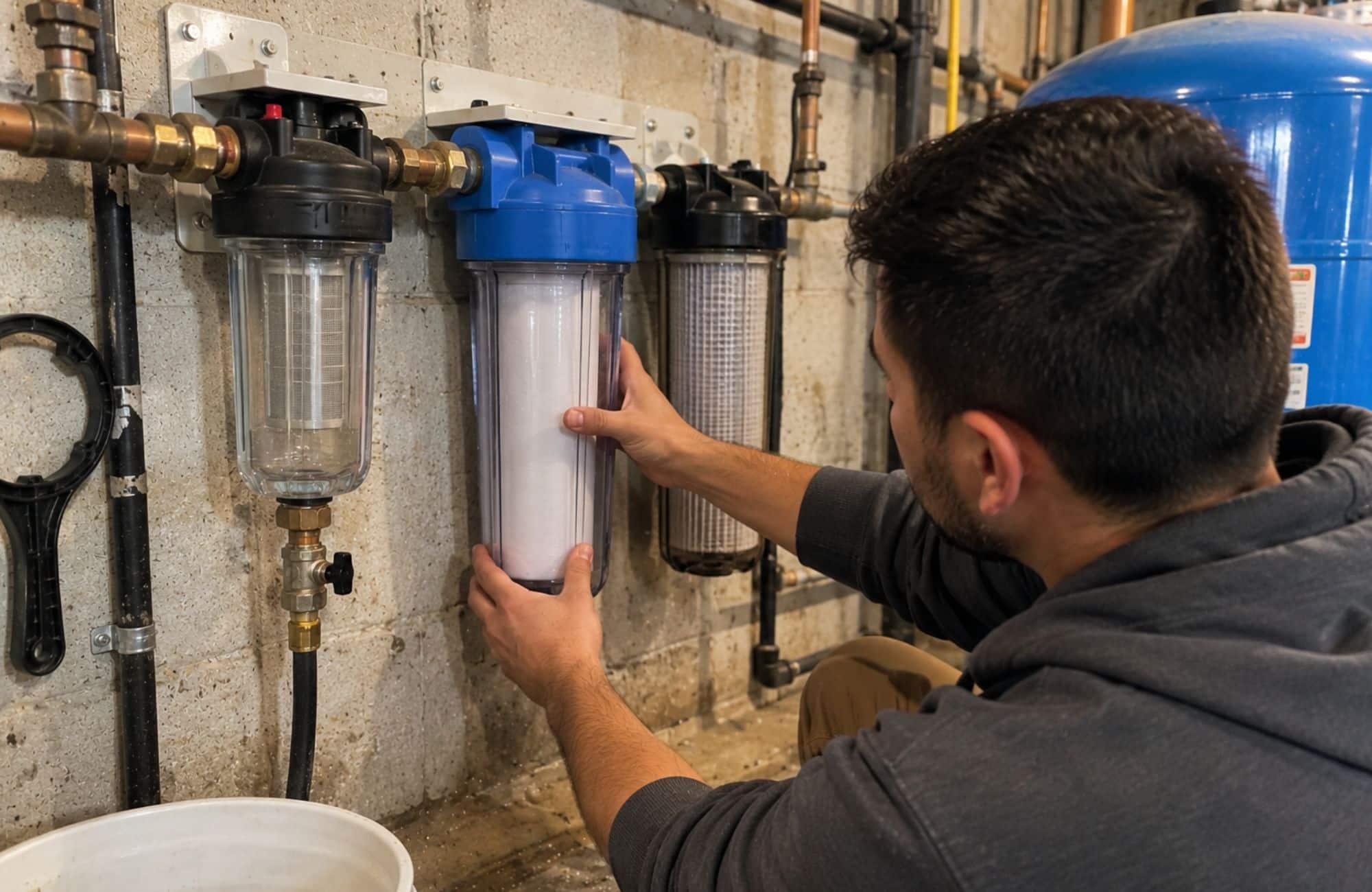
Sand collecting in your toilet tank, grit in your faucets, or sediment clogging your washing machine can make everyday water use frustrating. Choosing the right well water sediment filter can help capture these particles before they reach your plumbing and appliances. However, a filter that works for coarse sand may not be effective for fine silt, and the wrong system can create ongoing maintenance problems.
For homeowners using private wells in New Milford, CT, and surrounding communities, the choice often comes down to three options: spin-down, cartridge, and backwashing sediment filters. Each handles different water conditions and requires a different level of care. This guide compares their strengths, limitations, sizing needs, and maintenance requirements so you can make a more informed decision before choosing equipment.
Spin-Down vs Cartridge vs Backwashing: Quick Comparison
A spin-down filter is generally best for coarse sand and grit, while cartridge filters capture smaller suspended particles such as fine silt and rust flakes. Backwashing sediment filters are worth considering when a well produces persistent sediment that would cause cartridges to clog frequently. The best option depends on the particles, sediment volume, and household water demand.
The table below compares how these systems work in typical residential well-water applications. It also highlights the maintenance each one requires and the conditions where it may be less effective.
| Feature | Spin-Down Filter | Cartridge Filter | Backwashing Filter |
| Best application | Coarse sand and grit | Light to moderate fine sediment | Persistent or heavier sediment loads |
| Filtration method | Reusable mesh screen | Pleated or depth-filter cartridge | Tank containing filter media |
| Fine silt removal | Limited with coarse screens | Often suitable with proper micron rating | Depends on filter media and design |
| Maintenance | Flush collected sediment | Clean approved reusable cartridges or replace disposable ones | Monitor automatic backwash operation |
| Replacement needs | Screen when worn or damaged | Cartridges at required intervals | Media and valve parts as specified |
| Water pressure concerns | Restriction from loaded or undersized screen | Pressure loss as cartridge clogs | Incorrect sizing or insufficient backwash flow |
| Main advantage | Simple flushing and reusable screen | Wide range of particle ratings | Reduced routine cartridge handling |
| Main limitation | May allow fine particles through | Frequent replacement under heavy loads | Higher equipment complexity and drain requirements |
A well with large, visible sand particles may benefit from a spin-down filter ahead of a finer cartridge. A well with only occasional fine sediment may need a cartridge alone. When sediment is persistent, a properly sized backwashing system may be easier to manage over time.
Spin-Down Sediment Filters: Best for Coarse Sand and Grit
A spin-down sediment filter is commonly used when well water carries sand, coarse grit, or other relatively large particles. Water passes through a reusable screen, while collected material can be discharged through a flushing valve. This design makes spin-down filters useful as an initial filtration stage, especially when larger particles would otherwise clog a finer cartridge.
How a Spin-Down Filter Works
A spin-down filter directs water through a housing containing a mesh screen. The screen traps particles larger than its effective openings, while smaller particles can continue downstream. Many designs direct heavier collected material toward a lower collection area where it can be flushed out.
A Rusco spin-down filter is one example of this design. Rusco offers different screen openings and recommends choosing the coarsest screen that effectively captures the sediment present, rather than automatically choosing the finest available option.
For example, a coarse screen may handle visible sand without causing the maintenance problems associated with placing a 5-micron cartridge directly in heavy sediment. Actual performance depends on screen size, flow rate, and the type of particles entering the system.
Advantages and Limitations of Spin-Down Filters
The main advantage is that the screen can usually be cleaned and reused rather than replaced every time sediment collects. Homeowners can flush accumulated particles through the drain valve, although occasional disassembly and screen cleaning may still be necessary.
Spin-down filters can be useful because they:
- Capture larger particles before they reach cartridge filters.
- Allow flushing without routinely replacing filter media.
- Provide a visible collection area on many models.
- Work as a first stage in a multi-filter setup.
However, a spin-down system is not a complete solution for every sediment problem. Very fine silt can pass through a coarse screen, and excessively fine mesh can increase cleaning needs or restrict flow. The screen and housing must also be rated for the water pressure, temperature, and flow of the installation.
Spin-Down Filter Maintenance
Flushing frequency depends on how quickly sediment accumulates. A well producing regular amounts of coarse sand may require frequent flushing, while a well with only occasional particles may need much less attention. Following the manufacturer’s cleaning instructions is more reliable than assuming a fixed schedule.
Check the screen for embedded debris, tears, or damage when flushing no longer restores normal flow. Replacing a damaged screen is necessary because an opening can allow sediment to bypass the intended filtration stage.
Cartridge Sediment Filters: Best for Fine Silt and Rust Particles
Cartridge sediment filters are often suitable for wells with light to moderate amounts of fine sand, silt, or suspended rust particles. Water passes through replaceable or manufacturer-approved washable filter media that capture particles according to the cartridge design. They are widely used for whole-house filtration because several micron ratings and housing sizes are available.
Pleated vs Spun Sediment Cartridges
Pleated cartridges have folded filter media that provide a relatively large surface area for capturing particles. Some are designed to be rinsed and reused, making them practical for moderate sediment loads. Reusability depends on the cartridge material and manufacturer’s instructions, so not every pleated filter should be washed.
Spun polypropylene cartridges use layers of filter material to capture particles throughout their depth. They can work well for fine suspended sediment, but most are intended to be replaced rather than cleaned. A cartridge that repeatedly clogs soon after installation may indicate that a coarse prefilter, larger housing, or different treatment approach is needed.
Both designs can be effective when matched to the water conditions. The choice should account for sediment characteristics, filtration rating, available flow, and whether the homeowner prefers cleaning approved reusable cartridges or replacing disposable ones.
What Micron Rating Should You Choose?
A micron is one-millionth of a meter, and a filter’s micron rating describes the particle sizes it is designed to capture. Lower numbers generally indicate finer filtration, but a smaller number is not automatically better. Fine filters often accumulate sediment faster and may cause greater pressure loss when heavily loaded.
These are useful starting points for understanding common sediment filtration ratings. They are examples rather than fixed rules, since performance depends on cartridge construction and whether its rating is nominal or absolute.
| Micron rating | Typical consideration |
| 50–100 microns | Coarser particles and preliminary screening |
| 20–30 microns | Visible sediment and intermediate filtration |
| 5 microns | Finer suspended silt and particulate rust |
| 1 micron | Very fine particle filtration when specifically needed |
A nominal micron rating generally refers to capturing a stated proportion of particles near the rated size under specified test conditions. An absolute rating uses a more defined particle-retention standard. Because manufacturers may use different test methods, compare the actual specifications rather than assuming all 5-micron filters perform identically.
10-Inch vs 20-Inch Big Blue Filter Housings
Big Blue is a common name for larger-diameter filter housings that hold cartridges wider than standard slim cartridges. Ten-inch and twenty-inch versions are both used in residential filtration systems. The larger version generally offers more cartridge surface area and potential sediment-holding capacity when paired with a suitable cartridge.
A 10-inch housing may be adequate for a lower-demand installation with limited sediment. A 20-inch housing may be a better fit when the home needs higher flow or when a smaller cartridge requires frequent replacement. Neither decision should be based on household size alone.
Sizing should consider peak gallons per minute, pressure loss at the intended flow, the cartridge’s rated capacity, and the space available for maintenance. A household with several bathrooms or simultaneous appliance use may need more filtration capacity than a simple occupant count suggests.
Backwashing Sediment Filters: Best for Persistent Sediment Loads
A backwashing sediment filter uses a treatment tank filled with media that trap suspended particles as water passes through. At scheduled intervals or according to its control settings, the system reverses water flow to wash collected material to a suitable drain. This approach can reduce the need for frequent cartridge changes when sediment is persistent.
How Automatic Backwashing Works
During normal operation, water moves through the filter media, where suspended particles are retained. During backwashing, the valve changes the flow direction and uses water to loosen and discharge accumulated sediment. The system then returns to its normal filtration cycle.
The process must be matched to the filter media and the home’s well system. Some filters need a particular flow rate to lift and clean the media bed properly. If the well pump cannot provide enough backwash flow, collected material may not wash out as intended.
A backwashing filter is therefore more than a tank with an automatic valve. Media selection, tank diameter, control settings, drainage, pressure, and available water supply all affect the system’s suitability.
Benefits and Limitations
The biggest practical benefit is less routine handling of dirty filter cartridges. A properly selected backwashing system may be especially useful when sediment accumulates so quickly that replacing cartridges becomes expensive or inconvenient.
However, these systems have requirements that should be considered before installation:
- Adequate pump capacity for the manufacturer’s backwash flow requirement.
- A suitable drain and an approved connection arrangement.
- Enough water for each cleaning cycle without overtaxing the well.
- Space for the tank, valve, plumbing, and future servicing.
- Periodic checks of the valve, drain, and filter media.
A backwashing system also does not automatically solve every fine-sediment concern. Its actual filtration capability depends on the media used, and some applications may still need a polishing cartridge downstream.
When Is a Backwashing Filter Worth It?
A backwashing filter may be worth considering when cartridges clog repeatedly, sediment continues throughout the year, or a home has substantial water demand. The goal is to match the treatment equipment to an ongoing problem while reducing avoidable maintenance.
It may not be appropriate for wells with limited yield or pumps unable to meet the backwash requirement. In those situations, addressing the sediment source or using a different filtration arrangement may be more practical than installing an automatic tank.
Which Well Water Sediment Filter Is Right for Your Home?
The best well water sediment filter depends on what your well produces, how much sediment is present, and how much water your home needs at busy times. A screen can handle coarse particles, a cartridge can capture finer material, and a backwashing tank can manage some persistent loads. Testing and system measurements help narrow the choice, while the Connecticut Department of Public Health’s water treatment guidance offers additional information on choosing suitable treatment equipment.
Match the Filter to Your Water Conditions
The following examples show how different problems may influence filtration decisions. They are starting points for evaluation, not a substitute for checking the well and identifying the actual material in the water.
| Water condition | Filter approach to consider | What to check first |
| Visible coarse sand | Spin-down filter | Sediment source and screen opening |
| Occasional fine silt | Cartridge filter | Particle size and pressure loss |
| Sand mixed with fine particles | Spin-down followed by cartridge | Flow through both stages |
| Persistent heavy sediment | Properly sized backwashing filter | Well yield, media, and drain capacity |
| Frequent cartridge clogging | Larger housing, prefilter, or backwashing option | Whether sediment has increased |
| Orange stains without visible grit | Iron-specific treatment evaluation | Dissolved and particulate iron |
| Sudden sediment after pump work | Well-system inspection before choosing equipment | Pump, casing, and recent changes |
The appearance of water is a useful clue, but it cannot reveal every contaminant or confirm the cause of sediment. If the issue is mainly cloudiness rather than visible particles, the guide to causes of cloudy well water explains other conditions that may need investigation.
Check Whether Sediment Is Constant or Occasional
Sediment that appears only briefly after plumbing work may call for a different response than sand that collects every day. Track when the particles appear, whether they settle, and how quickly filters or faucet aerators clog. These observations help distinguish an ongoing filtration need from a change that deserves closer well-system inspection.
A simple toilet tank test can provide a useful clue. Remove the lid from a clean, accessible toilet tank, observe whether grit collects at the bottom over time, and avoid touching or disturbing internal components. Material found there shows that particles have reached the plumbing, but it does not establish their origin or whether the water is safe to drink.
Know When Filtration Is Not Enough
A sediment filter collects physical particles, but it does not repair damaged well equipment or reliably remove dissolved substances. If new amounts of sand appear suddenly, the problem could involve the well screen, casing, pump placement, or changing groundwater conditions. The U.S. Environmental Protection Agency recommends additional well-water testing when water quality changes or the well system undergoes repairs.
Removing visible sediment does not necessarily make well water safe to drink. Ordinary sediment filters are designed to capture particles, not reliably remove bacteria, viruses, or dissolved contaminants such as arsenic and nitrates. Water testing is needed to determine whether additional treatment is necessary.
Rust-colored water also needs careful assessment. Suspended rust flakes may be captured by sediment filtration, while dissolved iron may require different treatment after testing. When iron is confirmed as the concern, iron filtration systems can address water conditions that an ordinary sediment cartridge cannot.
Where Should a Sediment Filter Be Installed?
A whole-house sediment filter is commonly installed downstream of the well pressure tank and before the treatment equipment it is meant to protect. This arrangement helps avoid restricting the pump-to-tank connection and places filtration where it can serve household plumbing. However, the correct location depends on the system design and the equipment manufacturer’s requirements.
Pressure Tank and Filter Placement
A qualified installer should follow the equipment manufacturer’s instructions and verify that the filter placement does not interfere with the well system’s pressure switch, pressure tank connection, or pressure-relief protection. A filter that becomes clogged should not prevent these components from operating as designed. The installation must also account for required valves, existing treatment equipment, and applicable plumbing requirements.
Installers should also consider the pressure switch, pressure-relief components, required valves, and any existing treatment equipment. A filter should not be placed where it can interfere with the pressure controls or the system’s safety requirements.
Using Two Filtration Stages
Some wells benefit from more than one sediment filter because the water carries a mixture of particle sizes. A coarse filter can remove sand first, followed by a finer cartridge for smaller particles. This arrangement can reduce the burden on the finer stage, although both filters add some resistance to flow.
For example, a spin-down screen may be installed ahead of a larger cartridge housing when coarse sand repeatedly blocks fine cartridges. The correct order of other equipment, such as an acid neutralizer, water softener, iron filter, or disinfection system, depends on water testing and manufacturer instructions.
A professional water treatment evaluation can help determine whether a single filter or a staged arrangement is suitable for the well and existing plumbing.
Why Water Pressure Can Drop After Installation
Every filter creates some resistance as water passes through it. This becomes more noticeable when a cartridge fills with sediment, a screen is blocked, the housing is undersized, or the selected media is too restrictive for household demand.
Pressure gauges on both sides of the filtration assembly can help identify a rising pressure difference as a filter loads. Compare readings while water is flowing, because static pressure alone may not reveal a flow restriction. A pressure problem that continues with a clean filter may require evaluation of the pump, pressure tank, plumbing, or system sizing.
How to Maintain a Well Water Sediment Filter
Maintenance depends on the type of filter, the amount of sediment collected, and the manufacturer’s instructions. Spin-down screens need flushing and occasional inspection, cartridge filters need cleaning or replacement, and backwashing tanks need their cleaning cycles checked. Monitoring pressure and sediment buildup helps homeowners recognize when routine service is necessary.
Maintenance Requirements by Filter Type
No single maintenance interval applies to every private well. A filter handling heavy sediment may need attention much sooner than the same equipment on a well that carries only occasional fine particles.
| Filter type | Routine maintenance | When further service may be needed |
| Spin-down | Flush collected grit and inspect screen | Flushing does not restore flow |
| Disposable cartridge | Replace cartridge | Pressure loss or manufacturer’s service limit |
| Washable pleated cartridge | Clean only if approved by manufacturer | Damage, persistent clogging, or poor flow |
| Backwashing | Check cycles, valve, and drain discharge | Poor cleaning, media problems, or valve faults |
Disposable sediment cartridges should be replaced according to the manufacturer’s instructions and the conditions of the well water. Filters exposed to heavy sediment may require more frequent replacement, especially when reduced water flow or increased pressure loss indicates clogging. Follow the cartridge manufacturer’s service limits, particularly when the filter protects equipment with specific pretreatment requirements.
Warning Signs You Should Not Ignore
Reduced water flow, unexpectedly dirty cartridges, unusual grit in fixtures, or new sediment after heavy rain can indicate that conditions have changed. Do not simply keep choosing finer cartridges when sediment loading increases, because that may worsen pressure loss without identifying the underlying cause.
Keep notes on cartridge changes, flushing frequency, and pressure readings. If a filter that normally needs service after several months begins clogging within days, the change is useful information for a well inspection.
What Does a Sediment Filtration System Cost Over Time?
The cost of a sediment filtration system includes more than the initial filter, tank, or housing. Replacement cartridges, screen cleaning, drainage arrangements, maintenance, and eventual equipment servicing can all affect ownership costs. A less expensive filter may become inconvenient if heavy sediment causes frequent replacements, while a larger automatic system may not be justified for occasional grit.
Compare Total Maintenance, Not Just Purchase Price
A basic spin-down filter usually has relatively simple ongoing maintenance because its screen is reusable. Cartridge systems have recurring material costs, and those costs increase when filters clog quickly. Backwashing systems involve greater installation complexity and require water during cleaning cycles, but may reduce routine cartridge handling.
Equipment costs vary by filter type, capacity, and system requirements. Specifications, valves, labor, drainage, plumbing modifications, and filter media can substantially affect the total installed price. Request a quote based on your well conditions and household water needs rather than relying on equipment-only prices.
Consider the Cost of an Incorrect Filter
Installing a small, fine cartridge on a well with constant sand may lead to frequent replacements and noticeable pressure loss. Buying a large backwashing tank without checking available pump flow can create a different problem if the system cannot clean its media properly.
The better buying decision is the system that addresses the measured sediment problem while matching household flow and practical maintenance needs. A well inspection and water test can help avoid spending money on filtration that does not address the underlying issue.
Choose Filtration Based on Your Well Conditions
The right well water sediment filter depends on the particles entering your home, the amount of sediment present, and your system’s flow requirements. Identifying the source of persistent sediment and selecting properly sized equipment can help protect plumbing and appliances while avoiding unnecessary maintenance.
If you’re dealing with sediment in your Connecticut well water, Housatonic Valley Well Pump Services LLC can evaluate your well system and help identify an appropriate treatment approach. With 20+ years of hands-on experience, owner-operated service, and free quotes, the company can help you plan filtration around your actual water conditions. Request a water treatment evaluation to discuss the next step.
FAQs
Is a sediment filter necessary on well water?
A sediment filter is useful when a private well produces sand, silt, rust particles, or other suspended material that can clog plumbing and equipment. Not every well needs the same filtration system, and some wells may not need sediment treatment at all. The decision should depend on water observations, testing, and whether sediment is creating problems in the home.
What type of sediment filter is best for well water?
The best type depends on the size and amount of material entering the water supply. A spin-down filter is typically suitable for coarse sand, while a cartridge filter can capture finer suspended particles. A properly sized backwashing filter may be better for persistent sediment loads that would otherwise require frequent cartridge changes.
How can I filter sediment from my well water?
Start by identifying whether the material consists mainly of coarse grit, fine silt, or a mixture of particles. Choose a suitable filter or combination of filters based on those conditions, then check that the equipment can handle household flow without excessive pressure loss. Sudden or unusually heavy sediment should prompt a well-system evaluation before filtration is installed or upgraded.
How often should a well sediment filter be changed?
Disposable sediment cartridges should be replaced according to the manufacturer’s recommended schedule, which can vary with water usage and sediment levels. Heavy sediment may require more frequent changes, particularly when water flow decreases or pressure loss increases. Spin-down screens are generally flushed and reused, while backwashing filters clean their media through backwash cycles. Follow the equipment manufacturer’s maintenance instructions.
Is a 5-micron filter good for well water?
A 5-micron cartridge can be a useful option for fine suspended silt and some particulate rust when sediment levels are manageable. It may clog rapidly if water contains large amounts of coarse sand, making preliminary screening or staged filtration a better approach. The cartridge’s nominal or absolute rating, flow capacity, and pressure-loss specifications should also be considered.
Can a sediment filter reduce water pressure?
Yes, a sediment filter can reduce available flow and create a pressure drop, particularly when it becomes clogged or is too small for household demand. Very fine filter media may also restrict flow more than necessary for the particles present. Comparing pressure readings before and after the filter while water is flowing can help determine whether the filtration assembly is contributing to the problem.