


Last updated: October 02, 2026
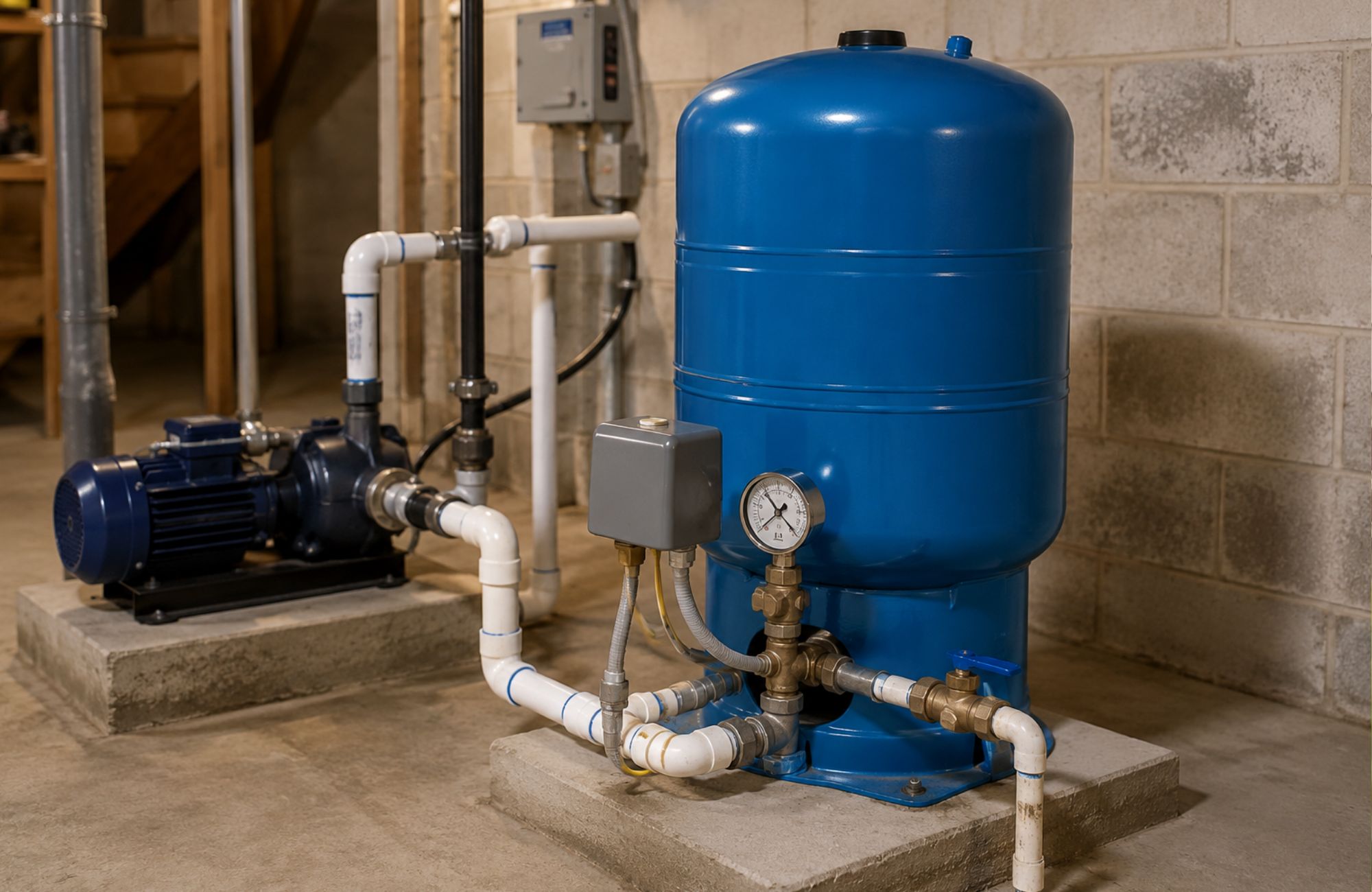
Your well pressure system depends on three main parts working together: the well pump moves water, the pressure tank stores water under pressure, and the pressure switch tells the pump when to turn on and off.
When something changes, you may notice low pressure, inconsistent water flow, frequent cycling, or a pump that runs longer than normal. Knowing how the pump, tank, and switch interact can help you understand what those symptoms may mean before equipment is repaired or replaced.
How Does a Well Pressure System Work?
A well pressure system uses a pump to move groundwater into the plumbing system and a pressure tank to provide stored water between pump cycles. As household water usage lowers system pressure, the pressure switch reaches its cut-on setting and starts the pump. The pump shuts off after pressure reaches the cut-off setting.
The basic cycle works like this:
- You open a faucet, shower, toilet, or appliance.
- Pressurized water leaves the well pressure tank.
- System pressure begins to drop.
- The pressure switch reaches its cut-on pressure.
- The well pump turns on.
- The pump supplies current water demand and refills the tank.
- System pressure rises.
- The pressure switch reaches its cut-off pressure.
- The pump shuts down.
- Stored pressure supplies water until the next cycle.
A standard pump system does not normally maintain the same pressure at every moment. Pressure rises and falls between its cut-on and cut-off settings. A correctly sized tank limits unnecessary pump starts while still providing usable water between cycles.
What Are the Main Parts of a Well Pressure System?
The main components are the well pump, well pressure tank, and pressure switch. A pressure gauge, check valve, air valve, tank tee, relief valve, pipes, and electrical controls support their operation. Because they work as one water system, a problem with one part can sometimes resemble a failure somewhere else.
| Component | Main function | Common problem signs |
| Well pump | Moves water from the well | Low pressure, no water, long run time |
| Pressure tank | Stores pressurized water and reduces cycling | Short cycling, pressure changes |
| Pressure switch | Starts and stops the pump | Pump fails to start or shut off |
| Pressure gauge | Shows system pressure | Stuck or inaccurate readings |
| Check valve | Limits backward water flow | Pressure loss after shutdown |
| Air valve | Provides access to tank air pressure | Incorrect air charge or water at valve |
| Tank tee | Connects controls and plumbing | Leaks, corrosion, restricted ports |
| Relief valve | Protects against excess pressure | Leakage or discharge |
What Does the Well Pump Do?
The pump moves water from the well into the home’s plumbing system. Many drilled wells use submersible pumps located below the water level, while some shallower wells use jet pumps above ground.
Pump selection depends on well depth, pumping water level, pipe size, elevation, flow rate, household water usage, desired pressure, and well yield. A larger or more powerful new pump is not automatically better if it does not match the well and plumbing system.
How Does a Well Pressure Tank Work?
The pressure tank works by combining water with a cushion of compressed air. In many modern bladder tanks, a rubber bladder or diaphragm separates the water from the air chamber.
As the pump forces water into the tank, the water compresses the trapped air. When you open a fixture, that compressed air forces stored water into the plumbing. This lets the home use water before the pump kicks on.
A pressure tank is different from a simple storage tank. Only part of its total volume becomes usable water between pump cycles. For a more detailed explanation of tank operation, see this guide to how a well pressure tank works.
What Does the Pressure Switch Do?
The pressure switch controls when the pump operates. When pressure reaches the cut-on setting, the switch activates the pump. When pressure rises to the cut-off setting, it shuts the pump down.
Pressure switch issues can involve worn contacts, blocked connections, incorrect settings, or electrical faults. The switch controls the pump, but it does not create water pressure by itself.
What Happens Inside a Well Pressure Tank?
Inside a modern well tank, compressed air and water work together. As the pump adds water, the air chamber becomes compressed. As the home uses water, that air expands and forces water toward the fixtures.
This changing balance allows the tank to provide pressurized water between pump cycles.
Bladder Tanks
Bladder tanks use a flexible rubber bladder to separate water from compressed air. The bladder expands and contracts as the pressure tank fills and empties.
If the bladder fails, the tank may lose normal drawdown, and the pump may begin short cycling. On a tank designed to keep water away from the air chamber, water coming from the air valve can be a warning sign of internal failure.
Diaphragm Pressure Tanks
Diaphragm tanks use a flexible barrier to separate air and water. Their operating principle is similar to bladder tanks: incoming water compresses air, and stored pressure later forces water into the plumbing system.
Tank construction varies among manufacturers, so service procedures should follow the instructions for the specific model.
Air-Over-Water Tanks
Older air-over-water tanks do not use a permanent bladder or diaphragm. Water and air share the tank, allowing air to gradually dissolve into the water.
These older water tanks may require more attention to maintain the proper air cushion. That is one reason maintenance advice for modern bladder tanks does not always apply to older tank designs.
What Pressure Should a Well System Be Set At?
Many residential well systems use 30/50 PSI or 40/60 PSI settings. The first number is the cut-on pressure, when the pump starts. The second is the cut-off pressure, when the pump stops. The correct pressure depends on the pump, tank, plumbing, elevation, treatment equipment, and household demand.
Higher pressure is not automatically better. The pump must still be able to reach its selected cut-off pressure while providing enough flow.
What Is the Difference Between 30/50 and 40/60 PSI?
A 30/50 system starts the pump at about 30 PSI and stops it at about 50 PSI. A 40/60 system starts around 40 PSI and stops around 60 PSI.
| Setting | Cut-on pressure | Cut-off pressure |
| 30/50 | About 30 PSI | About 50 PSI |
| 40/60 | About 40 PSI | About 60 PSI |
A 40/60 system operates through a higher pressure range, which may create a stronger pressure feel. It does not automatically increase flow rate or create additional water from the well.
What Should Well Tank Pressure Be?
For many precharged bladder-style tanks, air pressure is set about 2 PSI below the pressure switch cut-on point. That commonly means approximately 28 PSI for a 30/50 switch or 38 PSI for a 40/60 switch.
Amtrol’s well-tank guidance specifies a precharge 2 PSI below the pressure-switch cut-in setting. Before checking precharge, shut off electrical power to the well pump and relieve system water pressure to 0 PSI. Follow the tank manufacturer’s instructions, and do not add air to a tank that shows exterior corrosion or other signs of damage. If the tank’s condition is uncertain, have a licensed well professional evaluate it.
Why Does Pressure Tank Size Matter?
Tank size affects how much usable water, or drawdown, is available between pump cycles. A larger pressure tank will often provide more drawdown than a smaller model operating under similar conditions, but actual drawdown depends on the tank design and pressure settings.
An undersized tank can provide too little usable water between pump starts. That may cause frequent cycling and add wear to the pump motor, switch, and other electrical controls.
Tank sizing should account for pump flow rate, required pump run time, pressure settings, household water usage, and manufacturer instructions. A tank’s advertised gallon size should not be treated as the exact amount of water available to the home.
Manufacturer sizing guidance also uses factors such as pump flow rate, desired pump run time, and the system’s cut-in and cut-off pressures when selecting a pressure tank.
What Is a Waterlogged Pressure Tank?
A waterlogged tank has lost the air cushion needed for normal operation or has too much water compared with its available compressed air. When the tank can no longer provide normal drawdown, the pump may start and stop rapidly.
This behavior is called short cycling. Possible signs include:
- The pump kicks on after very little water use
- The pump shuts off quickly
- The pump starts again moments later
- The pressure gauge rises and falls rapidly
- Water pressure changes sharply
- Little usable water is available between cycles
A waterlogged tank is one possible cause of short cycling, but it is not the only cause. Incorrect air pressure, an undersized tank, leaks, or pressure switch issues can produce similar behavior.
Why Is Short Cycling Bad for a Well Pump?
Short cycling means the pump starts and stops more frequently than intended. Pump motors experience added electrical and mechanical stress during repeated starts, so frequent cycling can contribute to premature pump wear.
Potential causes include:
- Waterlogged pressure tank
- Incorrect tank air pressure
- Damaged bladder
- Undersized tank
- Plumbing leak
- Pressure switch problem
- Blocked switch connection
- Incorrect pressure settings
For a closer look at rapid pump cycling, see this guide to well pump cycling on and off.
Why Is My Well Water Pressure Low?
Low pressure can result from the pump, tank, plumbing system, water treatment equipment, or well supply. A clogged filter may restrict flow, a partly closed valve may limit water delivery, or a worn pump may struggle to build its normal pressure.
Common possibilities include:
- Clogged sediment filters
- Restricted treatment equipment
- Incorrect tank air pressure
- Pump wear
- Pressure switch issues
- Plumbing leaks
- Partly closed valves
- Heavy water usage
- Falling water level
- Low well yield
- Pipe restrictions
Because several conditions can produce similar symptoms, low pressure should be measured rather than diagnosed only by how the water feels at a faucet. More troubleshooting information is available in this guide to low water pressure from a well.
Why Is My Well Pressure Not Reaching 30 PSI?
A well system that cannot build pressure to 30 PSI may have a pump, plumbing, control, or water-supply problem. A worn pump, leak, low water level, restricted filter, damaged pipe, inaccurate gauge, or excessive demand can all affect pressure.
Possible causes include:
- Pump performance loss
- Underground or indoor leak
- Clogged filter
- Damaged supply pipe
- Low pumping water level
- Limited well recovery
- Pressure switch problem
- Faulty gauge
- Heavy simultaneous water use
If the pump runs continuously while the gauge stays below normal pressure, simply increasing the switch setting is not a reliable solution. The reason the system cannot build pressure should be identified first.
Water Pressure, Flow Rate, and Well Yield Are Different
Water pressure measures the force pushing water through the pipes. Flow rate describes how much water is delivered over time. Well yield describes how quickly groundwater becomes available to the well.
| Term | What it describes | Why it matters |
| Water pressure | Force within the plumbing | Affects how strong water feels |
| Flow rate | Water delivered per minute | Affects simultaneous fixture use |
| Pump capacity | Water the pump can move | Must support household demand |
| Well yield | Groundwater available over time | Limits sustainable supply |
A home can show normal pressure while a clogged filter limits flow. A strong pump can also move water faster than a low-yield well can replace it.
Increasing the pressure setting or installing a larger pump does not create additional groundwater.
Why Does Water Pressure Change During Household Use?
A standard well system naturally moves through a pressure range rather than maintaining the same pressure. As water leaves the tank, pressure falls. When the pump runs, pressure rises again.
Pressure changes may become more noticeable when several fixtures run at once. A shower, washing machine, dishwasher, outdoor faucet, or irrigation system can create higher water demand.
Pressure loss during these periods can involve pump flow capacity, well yield, pipe size, filters, tank operation, or household demand. A pressure drop does not automatically mean the home needs a larger pump.
What Is a Constant Pressure System?
A constant pressure system changes pump operation as household water demand changes, allowing pressure to stay within a narrower range than a standard on-and-off system. Many use a variable speed pump and electronic controls instead of running the pump at only one fixed speed.
The goal is more consistent water pressure, especially when several fixtures are operating at the same time.
How Does a Variable Speed Pump Work?
A variable speed pump changes speed to respond to demand. When water usage is low, the pump can operate more slowly. When demand increases, the controller can increase pump speed.
This lets the pump system provide a steadier flow while working to maintain the selected pressure.
What Does a Variable Frequency Drive Do?
A variable frequency drive, or VFD, changes the electrical frequency supplied to a compatible pump motor. Changing the frequency allows the motor and pump to operate at different speeds.
The basic process is:
- Household water demand changes.
- System pressure responds.
- The controller senses the change.
- The VFD adjusts pump speed.
- Water output changes to better match demand.
Actual performance still depends on pump capacity, plumbing, household demand, and available well yield.
Do Constant Pressure Systems Use Pressure Tanks?
Yes. A constant pressure system can still use a pressure tank, although some designs use a smaller tank than a traditional fixed-speed pump system.
The correct tank size depends on the variable speed controller, pump motor, manufacturer requirements, and overall system design. One tank-size range should not be applied to every constant-pressure installation.
For example, some variable-frequency-drive systems are designed to operate with a smaller pressure tank than a traditional fixed-speed system, but the controller manufacturer’s sizing requirements still apply.
Does Constant Pressure Mean Exactly the Same Pressure?
No system can maintain mathematically identical pressure under every possible condition. A constant-pressure controller works to keep pressure within a narrower range.
Very high water usage, low well yield, restricted piping, or inadequate pump capacity can still produce pressure changes.
Does a Variable Speed Pump Use Less Power?
A variable speed pump may run at reduced speed when water demand is lower. That does not mean every VFD system will automatically use less electricity.
Energy use depends on flow, pressure, pump selection, run time, motor efficiency, and system design. The primary benefit for many homeowners is steadier pressure and more responsive pump control rather than guaranteed energy savings.
Traditional vs. Constant Pressure Well Systems
A standard well system turns a fixed-speed pump on and off between two pressure settings. A constant-pressure system changes pump speed as demand changes to keep pressure steadier.
| Feature | Standard system | Constant-pressure system |
| Pump operation | Fixed speed | Variable speed |
| Pressure behavior | Rises and falls through a range | Maintained within a narrower range |
| Pressure tank | Commonly larger | Often smaller, depending on design |
| Controls | Mechanical pressure switch | Electronic controller or VFD |
| Complexity | Relatively simple | More electronic controls |
| Pressure feel | Normal pressure variation | More consistent pressure |
| Water supply | Limited by well and pump | Still limited by well and pump |
A constant-pressure system may be useful when a household experiences noticeable pressure swings during changing water demand. It cannot correct low well yield, clogged filters, leaking pipes, restricted plumbing, or other underlying water-system problems.
How Often Should You Drain a Well Pressure Tank?
Modern bladder and diaphragm pressure tanks generally do not need to be drained according to a routine calendar simply because they are pressure tanks.
Draining may be required to check the tank’s air precharge, make repairs, winterize equipment, or follow manufacturer instructions. Amtrol, for example, instructs users to turn off the well pump and relieve system water pressure before checking precharge.
Older air-over-water tanks operate differently and may require different maintenance. If pressure loss, short cycling, or reduced drawdown develops, testing the tank is more useful than repeatedly draining it without knowing the cause.
How Can You Tell if a Pressure Tank Has a Bad Bladder?
A damaged rubber bladder can change the balance between water and compressed air inside a pressure tank. Possible symptoms include short cycling, reduced usable water, unusual pressure changes, and difficulty maintaining the correct air charge.
Water coming from the air valve on a tank designed to keep water and air separate can also indicate an internal tank problem.
However, frequent cycling alone does not confirm a ruptured bladder. Incorrect precharge, tank sizing, leaks, or pressure switch issues can produce similar symptoms.
What Are Common Well Pressure System Problems?
Pressure-system problems often show up as changes in pump cycling, water pressure, flow, or pump run time. These symptoms provide useful clues, but several different faults may produce the same behavior.
| Symptom | Possible causes |
| Frequent cycling | Tank air charge, bladder, tank size, leak, switch |
| Low pressure | Restriction, pump, filter, valve, well supply |
| Pressure loss after shutdown | Leak or check-valve issue |
| Inconsistent water flow | Demand, restriction, pump, well yield |
| Pump runs continuously | Leak, pump problem, low water level |
| Pump will not start | Electrical problem, switch, control, pump |
| Water at air valve | Possible internal tank failure |
| No water | Pump, electrical, plumbing, control, or well problem |
Watch the pressure gauge when a problem occurs. A gauge that rises and falls very quickly may suggest limited tank drawdown, while a gauge that stays below cut-off while the pump continues running points toward a different group of possible problems.
How Are Well Pressure Problems Diagnosed?
A proper diagnosis looks at how the entire pump system behaves rather than replacing equipment based on one symptom. Pressure tank condition, switch operation, pump output, filters, plumbing, electrical controls, household demand, and well supply can all influence pressure.
Testing may include:
- Recording cut-on and cut-off pressure
- Watching pressure during water use
- Checking tank precharge
- Measuring drawdown
- Inspecting the pressure switch
- Checking the pressure gauge
- Examining the air valve
- Looking for visible leaks
- Checking filters and treatment equipment
- Evaluating pump output
- Reviewing well and water-level information
Homeowners can safely note symptoms such as changing pressure, unusual pump cycling, visible leaks, or gauge behavior. Electrical testing, pressure-switch adjustments, pump removal, and work on pressurized equipment should be handled by a qualified well professional.
How Can You Reduce Pump Wear and Pressure Problems?
A properly matched pump, tank, switch, and plumbing system helps reduce unnecessary cycling. Pay attention when the system starts behaving differently, especially if the change develops suddenly.
Signs worth watching include:
- The pump kicks on more frequently
- Water pressure changes suddenly
- Flow becomes inconsistent
- The pump runs when no water is being used
- The gauge no longer reaches normal pressure
- The pressure tank or pipes begin leaking
- The pump runs without reaching cut-off pressure
Connecticut DPH states that private-well owners are responsible for maintaining their own well systems and recommends having the well system inspected every five to ten years by a licensed professional, including the pump and tank components.
When Should a Well Pressure Problem Be Checked?
A pressure problem should be checked when the system can no longer complete its normal pressure cycle or when its behavior changes noticeably. Rapid cycling, continuous pump operation, sudden pressure loss, leaking equipment, repeated breaker trips, or complete water loss deserve prompt attention.
Watch for:
- Pump starting every few seconds
- Pump running continuously
- Pressure failing to reach cut-off
- Repeated breaker trips
- Leaking tank or fittings
- Relief valve discharge
- Water coming from the tank air valve
- Sudden major pressure loss
- Complete loss of water
Gradually weaker pressure or increasingly frequent cycling may still indicate developing tank, pump, plumbing, or pressure switch problems. Testing the system before changing settings can reduce the chance of replacing equipment that is still working correctly.
Understand What Your Well Pressure System Is Telling You
A reliable well system depends on the pump, pressure tank, pressure switch, plumbing, and water supply working together. The pump moves water, the tank provides stored pressure and usable water between cycles, and the switch controls when the pump starts and stops. When pressure or flow changes, testing the whole system helps separate a tank problem from a pump, plumbing, control, or well-supply issue.
For help with a well pressure tank, pressure switch, constant pressure system, or pump problem in New Milford and nearby Connecticut communities, Housatonic Valley Well Pump Services can evaluate the system and explain what may be causing the change in pressure or flow. Contact us to schedule an assessment and discuss the appropriate next step.
FAQs
What pressure should a well be set at?
Many residential systems use 30/50 PSI or 40/60 PSI settings. The first number is the cut-on pressure and the second is the cut-off pressure. The appropriate range depends on the pump, pressure tank, plumbing, elevation, and household demand.
What is the difference between 30/50 and 40/60 PSI well pressure?
A 30/50 system starts the pump near 30 PSI and stops it around 50 PSI. A 40/60 system starts around 40 PSI and shuts off around 60 PSI. A 40/60 setting provides a higher operating pressure range, but the pump and tank need to be suitable for it.
How often should you drain a well pressure tank?
Modern bladder and diaphragm tanks do not generally require routine draining on a fixed schedule. Draining may be needed when checking precharge, making repairs, winterizing, or following manufacturer instructions. Older tank designs may have different maintenance requirements.
Why is my well water pressure not reaching 30 PSI?
Possible causes include pump wear, a leak, a clogged filter, restricted pipe, low water level, excessive demand, inaccurate gauge, or control problem. The pressure reading alone cannot identify which condition is responsible. Pump output, plumbing, pressure, and well conditions should be checked together.
What causes short cycling on a well pump?
Short cycling can result from incorrect tank air pressure, a failed bladder, an undersized tank, leaks, or pressure switch problems. The pump starts repeatedly because the system loses pressure or has too little usable water between cycles. Continued frequent cycling can add wear to the pump motor and controls.
Does a constant pressure system still need a pressure tank?
Yes. Constant-pressure systems generally still use a pressure tank, although some variable-speed designs can use a smaller tank than a traditional system. Tank size depends on the pump, controller, motor, household demand, and manufacturer requirements.