


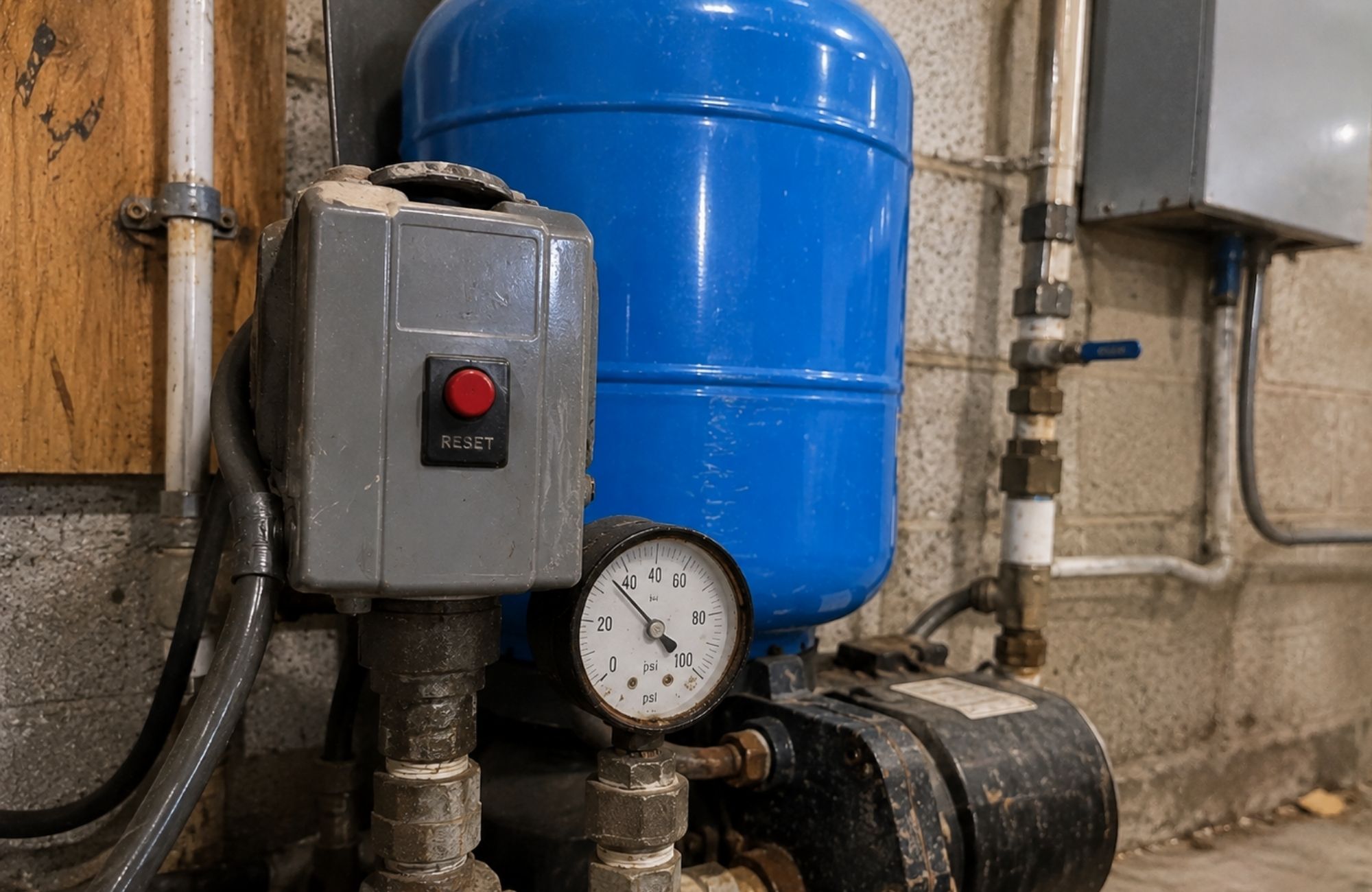
If your well pump keeps tripping reset buttons, something is repeatedly causing a protective device or control to shut the system down. Possible causes include low or unstable voltage, an overheated or failing control box, damaged wiring, excessive pump cycling, a binding pump, motor trouble, or certain low-water conditions. Pressing reset may restore water temporarily, but it does not correct the cause.
For Connecticut homeowners, repeated trips deserve attention before the pump stops completely or the home loses water again. Housatonic Valley Well Pump Services provides 24/7 emergency well pump service and can evaluate the pump, controls, pressure system, and well conditions when the cause is not obvious.
Why a Well Pump Keeps Tripping Reset Buttons
When a well pump keeps tripping reset buttons, a protective device is shutting the system down because it detects a condition the equipment should not continue operating through. Common causes include power problems, overheated controls, a failing capacitor or relay, damaged wiring, excessive motor load, or a worn pump. Repeated resetting does not repair the underlying condition.
The exact cause depends on the pump and control system. Franklin Electric’s current 2026 AIM Manual is an application, installation, and maintenance reference for submersible motors and controls, reflecting why proper troubleshooting looks at the full electrical and pumping system rather than one part alone.
Here are several possibilities a technician may need to investigate:
| What Is Happening | Possible Cause | What It Can Mean |
| Reset trips as the pump starts | Start-control, capacitor, relay, wiring, voltage, or motor problem | The motor may not be starting normally |
| Pump runs, then trips later | Heat, voltage, motor load, control-box problem, or pump wear | The system may be overheating or drawing abnormal current |
| Pump hums but does not build pressure | Electrical start problem or mechanical resistance | The motor may be energized without operating normally |
| Trips occur after frequent starts | Pressure-tank, switch, leak, or cycling issue may be contributing | Repeated starts can add heat and wear |
| Water disappears during heavy use | Well yield or water-level conditions may need evaluation | The pump may not be receiving or moving enough water |
| Electrical breaker trips | Circuit overload, short, ground fault, wiring, control, or motor problem | This is an electrical protection event, not a routine reset |
A pump that starts again after cooling is not necessarily fixed. The reason it became hot or overloaded still needs to be found.
First Identify What Is Actually Tripping
Before diagnosing the pump, identify what you are resetting. A tripped circuit breaker, a control-box overload, and a low-pressure cutoff on a pressure switch are different devices with different jobs. Treating them as the same can send you toward the wrong repair and can hide an electrical or water-supply problem.
Homeowners often use “reset button” as a general term. Knowing the location of the device can provide one of the most useful clues for professional diagnosis.
Not every submersible pump uses the same control-box design. Some systems place starting components in a separate box, while other pump and motor arrangements use different controls.
A breaker that repeatedly trips deserves particular care. Housatonic Valley’s guide to pressure-switch and well-pump breaker problems explains that a bad pressure switch can be one cause, but wiring, motor, and control faults can produce the same symptom.
Do not keep cycling a breaker or repeatedly pushing an overload reset to keep water flowing. Follow the reset instructions for the specific equipment, and if the protection trips again, leave further electrical diagnosis to a qualified professional.
How Pressure Tanks and Short Cycling Can Contribute
Pressure-tank problems usually do not trip a reset directly, but they can cause the pump to start and stop too often. This short cycling adds heat and wear to the pump and controls.
Possible causes include a waterlogged or undersized tank, loss of air charge, incorrect pressure-switch settings, or increased water demand. Rapid cycling or frequent switch clicking can indicate that the pressure tank and controls need to be checked.
If testing shows the tank is contributing to the problem, pressure tank installation and replacement services may be needed.
What You Can Check Safely Before Calling for Service
You can gather useful information without opening electrical covers or testing live circuits. Note which device tripped, what the pressure gauge shows, whether the pump hums, how often it cycles, and whether water pressure drops before shutdown. These observations help a technician separate control, tank, supply, and down-well problems more quickly.
Before touching anything, keep the manufacturer’s instructions for your specific pump and controls in mind. Do not remove the pressure-switch cover or control-box cover to perform electrical tests unless you are qualified to work on that equipment.
Useful observations include:
- Identify the reset location. Is it at the electrical panel, control box, or pressure switch?
- Check the pressure gauge. Note the pressure before the pump starts, while it runs, and when it stops if you can observe this without opening equipment.
- Listen to the system. Humming, rapid clicking, repeated starting, or unusual mechanical sounds are worth reporting.
- Watch the cycling pattern. A pump that starts every few seconds has a different problem pattern than one that runs for several minutes before shutting down.
- Look for visible leaks. Plumbing or tank-area leaks can make a pump run more frequently.
- Note household water demand. Record whether the failure happens during showers, laundry, irrigation, or other high-use periods.
- Record recent changes. Power outages, electrical work, pump service, tank replacement, drought conditions, or a change in water pressure may provide useful context.
Avoid replacing capacitors, relays, pressure switches, or other electrical components only because they seem like likely suspects. Several failures can produce similar symptoms, and unnecessary part swapping can make the real problem harder to identify.
When a Tripping Well Pump Needs Professional Diagnosis
Call for professional service when the same reset trips more than once, the breaker trips, the control box smells hot or burned, the pump hums without building pressure, or the home repeatedly loses water. These symptoms can involve high current, damaged wiring, failed controls, low well yield, or a pump that needs down-well testing.
A professional evaluation may compare system voltage and motor current with the equipment specifications, inspect wiring and controls, observe a complete pressure cycle, evaluate the pressure tank and switch, and determine whether the problem appears to be above ground or in the pump, motor, or cable.
The goal is not automatically to replace the pump. The same symptom can come from a smaller control or pressure-system problem, and testing should establish the cause before recommending repair or replacement.
Housatonic Valley provides well pump repair and system diagnosis throughout New Milford, Danbury, Litchfield, Wolcott, Brookfield, Southbury, and surrounding Connecticut communities. The company is owner-operated, has more than 20 years of hands-on experience, and owner Ralph Espinal is licensed in Connecticut and New York with full Connecticut J1 certification.
Get Help With a Well Pump That Keeps Tripping
A reset button that keeps tripping is a warning, not a normal operating step. The right repair depends on whether the problem is in the power supply, control box, pressure switch, pressure tank, well conditions, wiring, or pump motor. Repeated trips are a reason to diagnose the whole system before more damage or another no-water outage develops.
Housatonic Valley Well Pump Services provides well pump troubleshooting and repair for homeowners throughout its Connecticut service area. With 24/7 emergency availability, free quotes, and upfront pricing, the company can inspect the system and explain what the testing shows before recommending the appropriate repair. Contact us when your well pump keeps tripping or repeatedly leaves your home without water.
FAQs
What could be causing my well pump switch to keep tripping?
A well pump switch that keeps tripping may be responding to an electrical problem, abnormal motor load, control failure, overheating, or another pump-system condition. The cause depends on whether the device is a circuit breaker, motor overload, or pressure-switch cutoff. If it trips again after a reset, professional testing is a better next step than continuing to reset it.
Why does the reset button keep tripping?
A reset button keeps tripping because the protection device continues to detect the condition that caused the previous shutdown. Possible causes include voltage problems, a failing control component, motor or cable trouble, excessive heat, mechanical resistance, or pump wear. The reset itself does not tell you which of those problems is present.
What causes a well pump to turn off and on repeatedly?
A well pump that turns off and on repeatedly is usually short cycling. Possible causes include pressure-tank problems, lost air charge, an undersized tank, incorrect pressure-control settings, leaks, or other system conditions that cause pressure to change too quickly. Because rapid cycling increases starts and heat, it should be corrected rather than treated as normal operation.
What are the signs of a bad pressure switch on a well pump?
Possible signs of a bad pressure switch include failure to start or stop the pump at the expected pressure, erratic cycling, damaged contacts, or inconsistent operation. Those symptoms can also result from tank, wiring, control, or pump problems. A pressure switch should therefore be tested as part of the whole system rather than diagnosed from clicking or pressure changes alone.
Can a bad pressure tank make a well pump trip?
A bad pressure tank can contribute indirectly by causing the pump to cycle much more often than intended. Frequent starts create additional heat and wear in the motor, pressure switch, and controls, which can worsen an existing electrical or mechanical problem. Tank condition, pump cycling, and the tripping device should be evaluated together before deciding what needs replacement.