


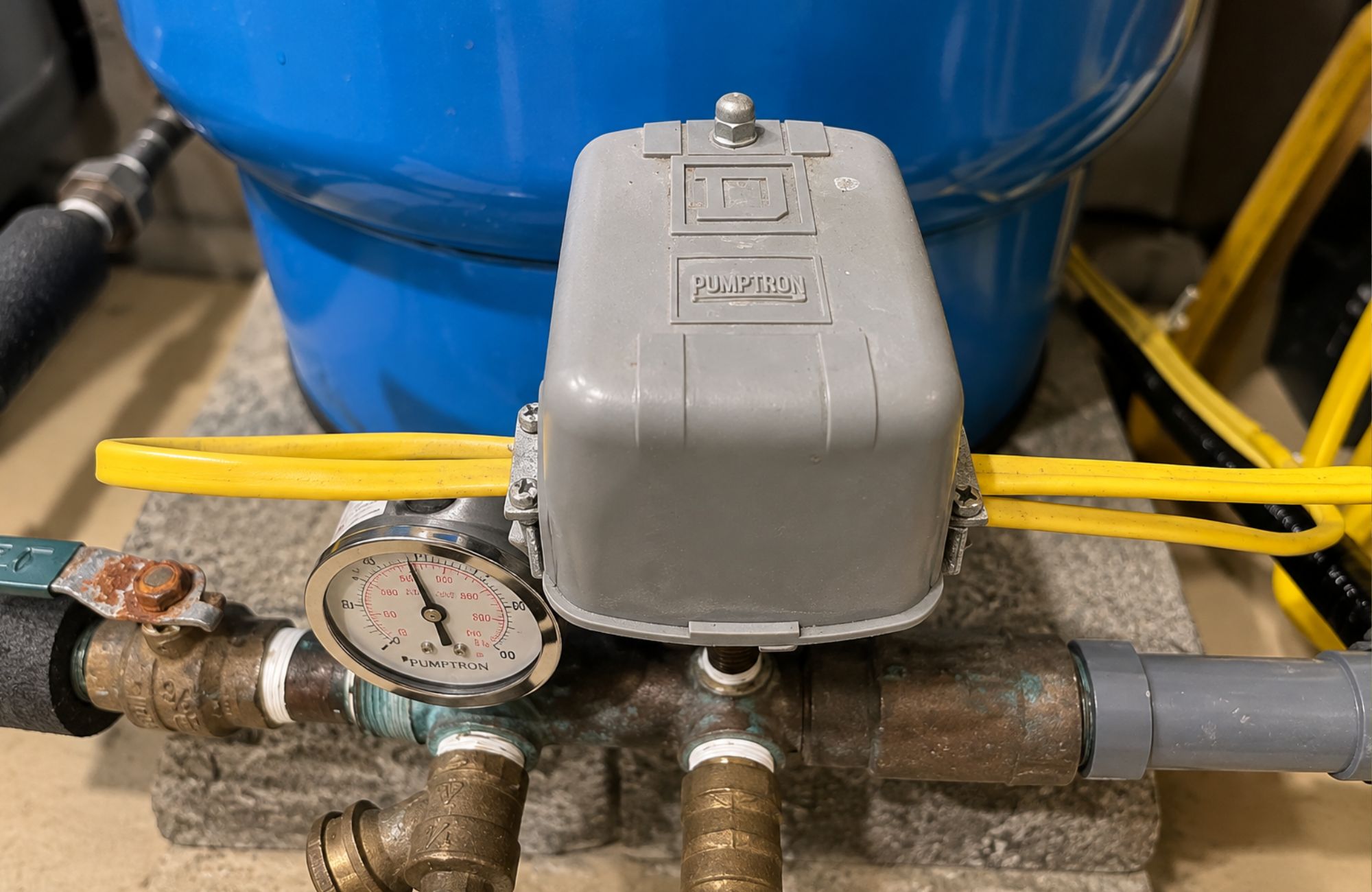
A well pump cycling on and off every few seconds may be short cycling. This problem can cause changing water pressure, repeated clicking near the pressure tank, and added strain on the pump system. For homeowners in New Milford, CT, the first step is to observe when the cycling happens rather than assume the pump itself has failed.
Several parts can cause similar symptoms, including the pressure tank, pressure switch, check valve, and household plumbing. Schedule a professional well-system evaluation if the pump repeatedly starts and stops or continues cycling when no water is being used.
What Does It Mean When a Well Pump Cycles On and Off?
When a well pump starts and stops rapidly, the system may be losing stored pressure or reaching its pressure-switch settings too quickly. This pattern is called short cycling. It often points to a pressure tank, switch, leak, valve, or sizing problem, but the sound alone cannot identify the exact cause.
In a conventional well system, the pressure tank stores water under air pressure. When you open a faucet or use an appliance, the tank supplies some water before the pump starts. Once pressure drops to the switch’s cut-in setting, the pressure switch tells the pump to run.
The pump then refills the tank and raises system pressure to the cut-out setting. It should shut off and remain off until normal water use lowers the pressure again. The usable water supplied by the tank between pump starts is called drawdown.
A system with very little drawdown may make the pump start after only a small amount of water leaves the tank. That creates the rapid start-and-stop pattern homeowners often describe as short cycling.
Is the Pump Cycling Normally or Short Cycling?
Some pump cycling is normal whenever your household uses water. The concern is a pump that starts, stops, and restarts within very short periods or cycles when every fixture is closed. A pump that runs continuously without shutting off is a different problem and may need a separate set of tests.
Before scheduling service, note what the pump does during a shower, after water use stops, and when the home is quiet. These details can help separate normal household demand from pressure loss, reduced tank capacity, or a control problem.
| What you observe | What it may mean | Recommended response |
| The pump runs steadily during water use and rests afterward | The system may be completing a normal cycle | Continue watching for changes |
| It turns on and off every few seconds while water is running | Short cycling may be occurring | Schedule a system evaluation |
| It cycles when every fixture is closed | A leak, valve problem, or pressure loss may be present | Check visible fixtures and arrange testing |
| It starts but does not reach shutoff pressure | This may be continuous running rather than short cycling | Reduce water use and request prompt service |
| The pressure gauge jumps or changes sharply | The tank, gauge, switch, or sensing line may need testing | Do not adjust electrical controls yourself |
There is no single acceptable number of pump cycles per hour for every well system. Motor size, pump output, tank drawdown, household demand, and control design all affect normal operation.
Manufacturer limits also vary by pump and motor model. This means cycle duration, run time, and the system’s normal pattern are more useful than a universal hourly number.
Common Causes of a Well Pump Cycling On and Off
Rapid cycling often begins when the system cannot store enough pressurized water between pump starts. A waterlogged or poorly charged pressure tank is one possible cause, but it is not the only one. Pressure-control faults, household leaks, failed valves, and mismatched equipment can create similar symptoms.
A Waterlogged Tank or Incorrect Air Pre-Charge
A pressure tank uses compressed air to push stored water into the plumbing. If the air cushion becomes too small, pressure may drop after only a limited amount of water leaves the tank. The pump starts, fills the available space quickly, shuts off, and repeats the cycle.
A failed internal bladder may prevent the tank from maintaining the proper separation between air and water. Low air pre-charge can cause related symptoms even when the bladder has not failed.
Many bladder-style pressure tanks use a pre-charge setting that is 2 PSI below the pressure switch’s cut-in setting. However, the tank must be emptied and depressurized before the reading is checked. The correct setting also depends on the tank manufacturer and system design.
Adding air without confirming the tank’s condition may be unsafe. Corrosion, internal damage, air loss, or a failed bladder can change the correct repair.
A Faulty Pressure Switch or Inaccurate Gauge
The pressure switch responds to system pressure and controls when the pump starts and stops. Worn contacts, damaged wiring, debris in the pressure-sensing connection, or incorrect settings can cause irregular pump operation.
A faulty pressure gauge can also mislead the person testing the system. The gauge may appear to show the proper cut-in or cut-out pressure while the actual system pressure is different.
A technician may need to verify the gauge before making conclusions about the tank or pressure switch. Do not remove the switch cover or touch the wiring because the enclosure contains electrical components.
A Plumbing Leak or Running Fixture
A dripping faucet, running toilet, leaking outdoor hydrant, or hidden pipe leak can lower pressure after the pump shuts off. The pressure switch may then restart the pump even though no one intended to use water.
Cycling that continues when every known fixture is closed makes pressure loss more likely. It does not reveal the location of the problem, however.
The leak may be inside the home, below a fixture, in an underground water line, or elsewhere in the well system. A small leak can still trigger repeated pump starts if it continues long enough.
A Failed Check Valve or Foot Valve
A check valve allows water to move in one direction. If it no longer seals correctly, water may flow backward after the pump shuts off. System pressure drops, the switch starts the pump, and the cycle repeats.
A valve problem can look similar to a household plumbing leak because both allow stored pressure to disappear. Finding the difference may require isolating sections of the plumbing or watching how pressure changes while the home is not using water.
The valve’s location may vary by system. Some repairs require access to equipment inside the well, so this is not normally a homeowner repair.
An Undersized Pressure Tank
An undersized pressure tank may provide too little drawdown for the pump and the household’s water demand. The pump then starts more often because the tank cannot supply much stored water between cycles.
Pressure tanks are not sized only by their total gallon label. Their usable drawdown changes with the pressure-switch settings and air pre-charge.
A properly sized tank should support suitable pump run time and reduce unnecessary starts. The correct size depends on pump output, motor size, pressure range, household use, and the system manufacturer’s requirements.
An Oversized Pump or Equipment Mismatch
A high-output pump can raise pressure quickly when paired with a tank that provides limited drawdown. The system reaches cut-out pressure, shuts off, and then restarts soon after water use resumes.
This does not always mean the pump itself must be replaced. The tank, switch settings, flow controls, and household demand all need to be considered together.
Constant-pressure systems also operate differently from conventional pressure-switch systems. Their cycling should be evaluated according to the controller and pump manufacturer’s specifications.
What Can You Safely Check at Home?
You can gather useful information without opening electrical controls or changing pressure settings. Focus on when the cycling begins, how long the pump runs, and whether water is being used. These observations help guide the testing process without creating an electrical or pressure-vessel hazard.
Spend several minutes watching and listening to the system under different conditions. Write down what happens rather than relying on memory.
- Close faucets and water-using appliances, then listen for additional pump starts.
- Check toilets for water that continues flowing into the bowl.
- Look for dripping faucets, wet fittings, or damp areas near visible pipes.
- Watch the pressure gauge from a safe distance and note rapid changes.
- Record how many seconds the pump runs before it stops.
- Note whether water pressure surges, weakens, or pulses at fixtures.
- Listen for repeated switch clicks, humming, or new mechanical sounds.
- Check whether the cycling happens during water use, after water use, or at random.
Tapping the side of a pressure tank may provide a rough clue, but it cannot confirm the tank’s condition. Tank construction, location, insulation, and the amount of water inside can all change the sound.
Do not remove the pressure-switch cover, handle wiring, or add air to a tank whose condition is unknown. Pressure-tank service requires shutting off pump power, draining the system, and confirming that the tank is structurally sound.
How Does a Professional Find the Root Cause?
A professional diagnosis compares pump operation, tank performance, system pressure, and water use. The goal is to identify where pressure or usable storage is being lost before recommending replacement parts. Replacing a tank or switch based only on rapid clicking may leave the actual problem unresolved.
The exact process depends on the well system, but an evaluation may include the following steps.
1. Observe a Complete Pump Cycle
The technician records when the pump starts, how quickly pressure rises, and whether the pump reaches its shutoff setting. The length of the cycle can provide useful information about drawdown and pump output.
The system may also be observed with one or more fixtures running. This shows how the pressure responds to actual household demand.
2. Verify the Gauge and Pressure Controls
The pressure gauge, cut-in setting, cut-out setting, pressure switch, and sensing connection may be checked. Electrical contacts and wiring may also need inspection.
This step helps determine whether the controls are responding to real pressure changes or creating irregular operation.
3. Measure Pressure-Tank Performance
The tank’s air pre-charge, drawdown, exterior condition, and bladder response may be tested using the proper shutdown procedure. The technician may compare those results with the tank label and system pressure settings.
A tank that has lost air may need adjustment. A tank with a failed bladder, water at the air valve, or structural damage may require replacement.
4. Test for Pressure Loss
The system may be observed with every household fixture closed. A continued pressure drop can point toward a plumbing leak, leaking hydrant, failed valve, or water draining back toward the well.
Further testing may be needed to locate the exact source. This matters because repairing the wrong component will not stop the cycling.
5. Review Pump and Tank Sizing
Pump flow, motor size, tank drawdown, pressure range, and household water demand are compared. A correctly working component may still perform poorly when it does not match the rest of the system.
Arrange a well pump system evaluation when the pump repeatedly starts and stops or shows a sudden change from its normal pattern.
How Do You Stop Well Pump Short Cycling?
Stopping well pump short cycling starts with finding the source of the pressure loss or reduced drawdown. The problem may involve the pressure tank, air pre-charge, pressure switch, check valve, plumbing leaks, or equipment sizing. Adding air or replacing a switch without testing can leave the real cause unresolved.
A tank with the correct pre-charge and an intact bladder may only need adjustment, while a damaged or waterlogged tank may require replacement. Leaks, failed valves, clogged pressure-sensing connections, and inaccurate gauges should also be repaired or corrected as needed. After service, the system should complete several steady cycles and remain off when no water is being used.
A pressure-tank system inspection can confirm whether the tank, switch, air charge, or system sizing is causing the rapid cycling.
When Should You Schedule Well Pump Repair?
Schedule professional service when the pump restarts every few seconds, cycles with all fixtures closed, or causes sharp pressure changes. Prompt testing is also appropriate when you smell overheated electrical parts, hear new humming, see water leaking around the equipment, or lose water at household fixtures.
Warning signs that should not be ignored include:
- Rapid clicking at the pressure switch
- Very short pump run times
- Cycling with no known water use
- Water leaking around the tank or controls
- Breaker trips, burning odors, or electrical noise
- A sudden change from the system’s usual pattern
- Little or no water at household fixtures
- A pressure gauge that changes sharply or does not respond
Shut off power only when you can reach the correct breaker safely. Do not touch wet electrical equipment or remove control covers. For an urgent no-water problem, electrical odor, or pump that will not stop cycling, request 24/7 emergency well pump service.
Get Help With a Rapid-Cycling Well Pump
A well pump that turns on and off too often may have a problem with the pressure tank, pressure switch, check valve, or household plumbing. A professional inspection can identify the cause, restore more consistent operation, and reduce unnecessary strain on the system.
Housatonic Valley Well Pump Services helps homeowners in New Milford and nearby Connecticut communities diagnose and repair well pump cycling problems. Contact us to schedule an inspection or request emergency service.
FAQs
How do I stop my well pump from short cycling?
Start by checking for visible leaks, running toilets, and cycling when every fixture is closed. Do not open the pressure switch or add air to an unknown tank. A well professional can measure tank drawdown, verify the switch and gauge, and test for pressure loss before recommending a repair.
Why does my well pump keep turning on and off every few seconds?
The pressure tank may have little usable drawdown, or the system may be losing pressure through a plumbing leak or failed valve. A faulty pressure switch, blocked sensing connection, or equipment mismatch can also cause rapid starts. The timing alone cannot identify which component has failed.
How often should a well pump cycle on and off?
A well pump should cycle according to household water use, tank drawdown, pump output, and the control design. It should not normally restart every few seconds or cycle repeatedly when no water is being used. Manufacturer limits and recommended run times vary, so there is no universal cycles-per-hour rule.
How can I tell if my well pump is short cycling?
Listen for repeated starts and stops separated by only a few seconds or a short period. You may also notice pressure surges, rapid gauge movement, or a pump that starts after very little water use. Record the run time and whether fixtures were open so the behavior can be compared with the system design.
Can a running toilet make a well pump cycle?
Yes. A running toilet continuously uses a small amount of water, which can lower system pressure until the switch starts the pump. Repairing the toilet may stop that demand, but continued cycling afterward may point to another source of pressure loss or reduced tank storage.
Can short cycling damage a well pump?
Repeated starts can add strain to the motor, electrical controls, and other system components. The level of risk depends on the pump, motor, cycle duration, and manufacturer’s start limits. Prompt diagnosis can reduce continued wear and help prevent a small pressure-system problem from affecting additional equipment.