


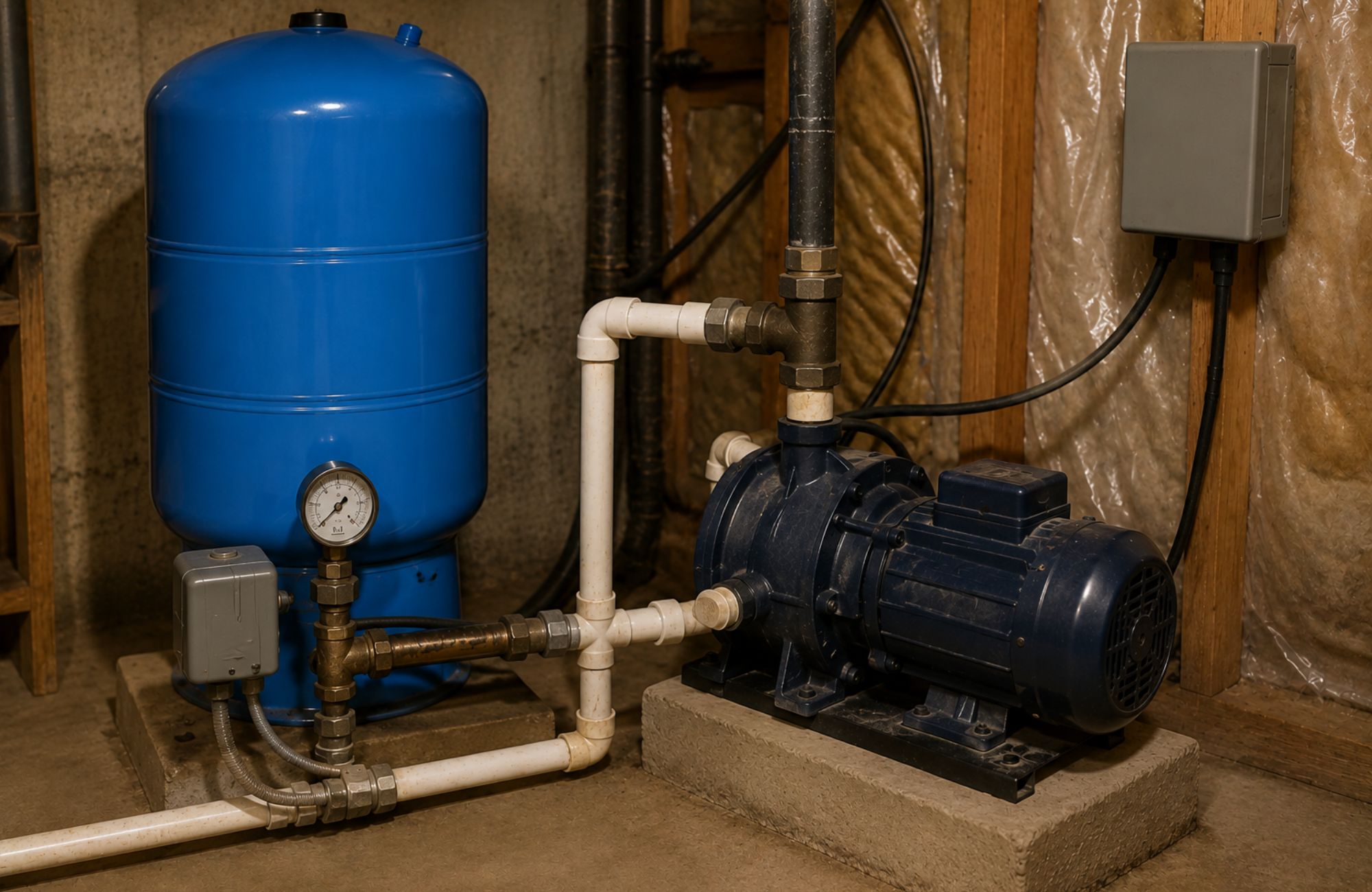
A well pump humming but not pumping may have an electrical starting problem, a stuck mechanical part, or a water-flow issue. The sound alone cannot identify the failed component. If your home has little or no water, your first steps should protect the equipment and help a well professional narrow down the cause.
This guide is for private-well homeowners in New Milford, CT, who hear an unusual hum or buzzing sound. For an urgent no-water problem, contact Housatonic Valley Well Pump Services for 24/7 emergency well pump service.
What to Do When Your Well Pump Is Humming
If your well pump hums but does not send water to the house, shut it off when pressure does not rise, the breaker trips, the equipment becomes unusually hot, or you smell burning. Repeated restarts may add damage. Record what you notice, then arrange a qualified well-system inspection.
A humming sound shows that electrical or mechanical activity is occurring somewhere in the system. It does not prove that the capacitor, pressure switch, motor, or pump has failed.
Take these immediate steps:
- Stop heavy water use. Turn off irrigation, washing machines, dishwashers, and other fixtures that may call for water.
- Shut off the pump breaker when needed. Leave it off if the pump cannot build pressure, the breaker trips again, or the equipment smells burned.
- Note where the sound is loudest. Listen near the jet pump, pressure tank, control box, electrical panel, and well casing without opening covers.
- Check the pressure gauge. Record whether it stays at zero, rises slowly, or moves normally.
- Call a qualified well professional. Do not keep restarting the system while the cause remains unknown.
Do not test live voltage, touch a capacitor, bypass a pressure switch, or open an energized control box. Connecticut Department of Public Health guidance states that well pumps need specialized wiring and should be serviced by a properly qualified professional.
Why Is My Well Pump Humming but Not Pumping?
A well pump humming but not pumping usually points to one of three problem groups: the motor cannot start, a rotating part is stuck, or the pump runs without moving water. The correct diagnosis depends on the pump type, electrical supply, controls, well level, piping, and mechanical condition.
Electrical Starting Problems
A pump motor needs the correct voltage and starting force to begin turning. Possible electrical causes include damaged wiring, low or unstable line voltage, a faulty pressure switch, failed motor windings, or a problem with a relay, capacitor, control box, or electronic drive.
A failed start capacitor can prevent some single-phase motors from starting. A faulty run capacitor may also affect systems designed to use one. Capacitors can retain a dangerous electrical charge after power is disconnected, so testing or replacement is not a safe homeowner task.
An external control box is also system-specific. Certain three-wire submersible pumps use one, while other motors keep their starting parts sealed inside the motor. This means online advice about replacing a control-box capacitor does not apply to every well system.
Mechanical Binding
The motor may receive power but fail to rotate because the impeller, shaft, rotor, or bearings are stuck. Sand, sediment, corrosion, worn bearings, or internal damage can place a heavy load on the motor and produce a strained hum.
A technician may inspect the motor shaft on an accessible above-ground jet pump after safely disconnecting power. That check does not apply to a submersible pump installed inside the well.
The Motor Runs but Water Does Not Move
Sometimes the motor starts, but the pump does not deliver water or build normal pressure. A jet pump may have lost prime, developed an air leak in the suction line, or encountered a blocked foot valve, pipe, valve, or impeller.
Other possible causes include a low well-water level, damaged drop pipe, worn hydraulic parts, or a pump that has run dry. These conditions require different tests and repairs, so humming alone cannot reveal which part has failed.
| What you notice | Possible problem category | Next step |
| Steady hum without normal motor operation | Starting fault or mechanical binding | Switch off power and arrange testing |
| Motor sound but no pressure rise | Lost prime, low water, blockage, leak, or pump damage | Stop the pump and inspect the full system |
| Breaker trips during startup | Electrical fault, overload, or stalled motor | Leave the breaker off |
| Hot equipment or burning smell | Motor or electrical damage | Do not restart |
| Air sputters from faucets | Low water, suction leak, piping, or pressure problem | Limit water use and request service |
How Pump Type Changes the Possible Cause
Troubleshooting changes with the system design. Above-ground jet pumps may lose prime or develop suction-side problems, while submersible pumps place the motor and pump inside the well. Some systems use an external control box, while others use sealed starting parts or electronic controls.
Above-Ground Jet Pumps
A jet pump is often located inside a basement, utility area, or another protected space. Since the motor and pump housing are accessible, a technician may inspect the shaft, impeller, bearings, prime, suction piping, foot valve, pressure switch, and starting components.
Jet pumps depend on an airtight suction line and enough available water. A loose fitting, damaged pipe, blocked valve, or loss of prime may stop water flow even when the motor continues to make noise.
Submersible Well Pumps
A submersible pump sits inside the well casing, usually near the bottom of a drilled well. Because the pump is underground, a homeowner cannot inspect its shaft or impeller.
Diagnosis may require electrical measurements, cable checks, water-level testing, and sometimes removal of the pump. The technician may also check the drop pipe and other down-well parts that carry water to the home.
Constant-Pressure Systems
Some homes use an electronic drive and pressure sensor rather than a basic pressure-switch setup. These systems may display fault codes that help narrow the problem.
Private-well homes around New Milford can have different depths, pressure settings, and equipment designs. Advice for one system may not apply to another.
Safe Checks Homeowners Can Make
Homeowners can make several useful observations without opening electrical equipment. Check more than one faucet, read the pressure gauge, note where the sound is loudest, and look for visible leaks. Do not test live voltage, touch capacitors, bypass controls, or repeatedly reset a breaker that trips.
Start by checking both hot and cold water at more than one fixture. A blocked faucet, closed valve, or frozen branch pipe can look like a pump failure when other areas of the home still have water.
Record these details for the service technician:
- Whether the whole house has no water
- The pressure-gauge reading
- Whether the breaker has tripped
- Whether the hum is constant or brief
- Where the sound is loudest
- Whether faucets release air or sediment
- Whether you see a leak or wet ground
- Whether the problem followed an outage or surge
- Whether household water use was recently high
These observations may help separate a pump problem from a pressure tank, switch, pipe, valve, control, or low-water condition. They do not confirm which component needs repair.
How a Well Professional Diagnoses the Problem
A well professional checks the pump, controls, pressure, wiring, water flow, and well level before recommending a repair. Testing may include the breaker, pressure switch, motor response, capacitors, prime, valves, and down-well wiring. This helps avoid replacing a part without confirming the actual cause.
The technician may also test voltage under load, check motor current, inspect visible equipment, and measure well-water level when low supply is suspected. Pulling a submersible pump is usually considered only when the test results point to a down-well problem.
Housatonic Valley Well Pump Services is owner-operated and has more than 20 years of hands-on experience. Ralph Espinal is licensed in Connecticut and New York and holds full J1 certification in Connecticut. Schedule well pump service for a diagnosis based on the complete system.
Does a Humming Pump Need Repair or Replacement?
A humming pump does not automatically need replacement. An accessible control, wiring, pressure-switch, or starting component fault may be repairable. A seized motor, failed down-well pump, damaged cable, or major piping problem may require replacement. Testing, equipment condition, well depth, and access should guide the decision.
A technician should also consider pump type, horsepower, age, wiring condition, piping, household demand, and well yield. A newer pump with an isolated external-control fault presents a different decision from an older submersible motor with confirmed internal damage.
The humming sound cannot predict the final cost. Price depends on the pump type, well depth, access, parts, wiring, piping, and whether a submersible pump must be pulled. Housatonic Valley provides free quotes and upfront pricing after evaluating the system.
Connecticut Considerations After Pump Work
Connecticut wells can differ in depth, yield, construction, and pump setup, even within the same town. When repair work exposes the well interior, replaces the pump, or opens water piping, disinfection and water testing may be recommended. The correct next steps depend on the work performed.
Connecticut DPH recommends water testing after certain repairs to a well, pump, or water piping. Disinfection may also be needed when the well or plumbing has been opened to possible contamination.
A humming pump in New Milford should not be blamed on geology or low groundwater from sound alone. Pump depth, water level, household demand, wiring, equipment condition, and well yield all need to be considered.
Get Help With a Humming Well Pump in New Milford
A humming well pump with little or no water is a warning, not a part-specific diagnosis. Turning the system off when it stalls, overheats, or trips the breaker may limit added damage. A qualified inspection can identify whether the problem involves power, controls, the pump, piping, or the available well supply.
Housatonic Valley Well Pump Services provides owner-operated well pump repair, replacement, and 24/7 emergency availability in New Milford and surrounding Connecticut communities. Request service for a free quote and upfront pricing.
FAQs
Should I Be Able to Hear My Well Pump Running?
You may hear a steady operating sound from an above-ground jet pump when the system starts. A submersible pump inside the well may be much harder to hear from the house. A new hum, grind, screech, rattle, or repeated click deserves attention when it comes with low pressure or no water.
What Are the Signs That a Well Pump Is Going Bad?
Possible signs include no water, falling pressure, long run times, breaker trips, air at faucets, and unusual sounds. The pressure tank, switch, controls, pipes, or well-water level can create similar symptoms. A full-system inspection is more reliable than diagnosing the pump from one clue.
What Does a Failing Well Pump Sound Like?
A failing pump or related component may hum, buzz, grind, rattle, screech, or click repeatedly. A hum may come from a stalled motor, control box, pressure switch, or another electrical component. The sound’s location and the results of electrical and water-flow tests help identify the cause.