




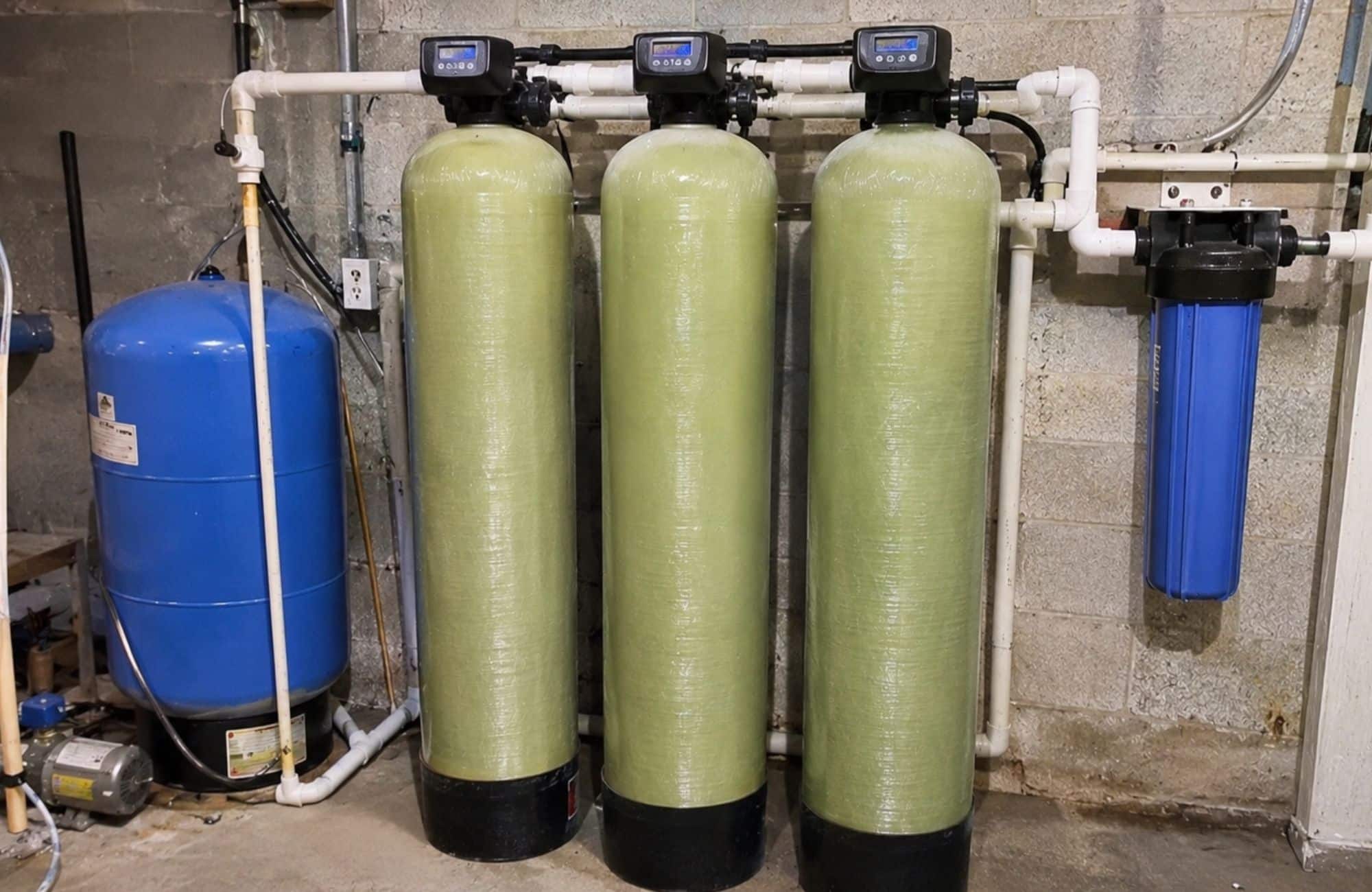
An air injection iron filter can be a practical whole-house treatment option when well water contains dissolved iron and, under the right conditions, manganese or hydrogen sulfide. Instead of relying only on a replaceable cartridge, the system uses oxygen to change certain dissolved substances into particles that filter media can capture.
For Connecticut homeowners, the main question is not simply whether air injection works. It is whether the well’s water chemistry, pump capacity, household demand, and treatment goals fit the system. Water testing and basic well-system measurements should come before choosing equipment.
What Is an Air Injection Iron Filter?
An air injection iron filter is a treatment system that combines oxidation and filtration, often inside one media tank. The filter system introduces air into the water so oxygen can react with dissolved iron. After oxidation changes that iron into solid particles, the filter media captures those particles before the water continues through the house.
This approach differs from an ordinary sediment filter because dissolved iron can pass through mechanical filtration before it has been oxidized. It also differs from a conventional water softener, which relies on ion exchange rather than creating an oxidation zone. The Connecticut Department of Public Health lists aeration followed by filtration among the treatment methods used for dissolved iron and manganese.
Combination systems may also be configured to reduce manganese or hydrogen sulfide when the water chemistry and selected media support those applications. The exact media, control valve, tank size, flow rate, and operating conditions matter more than the general label “air injection.”
How Does Air Injection Oxidation Work?
Air injection oxidation uses oxygen to convert dissolved substances into forms that can be filtered. During normal operation, the control system maintains or replenishes an air pocket inside the treatment tank. Incoming well water contacts that oxygen before passing through the filtration media, beginning the oxidation and iron removal process.
The process generally works in four stages:
- Air enters the system. Depending on the equipment design, a control valve, air-draw assembly, injector, or similar component introduces air.
- Water contacts oxygen. Dissolved iron reacts with oxygen and begins changing from a soluble form into oxidized particles.
- Filter media captures the particles. Water passes through the treatment media, where oxidized iron and other treatable material are retained.
- The system backwashes. The control valve periodically reverses water flow to clean the media and send accumulated material to a drain.
Backwashing is part of normal system operation rather than an optional cleaning step. How often it occurs and how much water it uses depend on the valve programming, tank size, media, contaminant loading, and manufacturer requirements. The system should therefore be sized around both household water demand and the available flow rate during backwashing.
What Can an Air Injection Combination Filter Treat?
An air injection combination filter is mainly useful when oxidation can convert a dissolved water-quality problem into material the filter can capture. Dissolved iron is the main example. Manganese and hydrogen sulfide may also respond to oxidation, but their treatment depends more heavily on concentration, pH, media, and other water conditions.
Dissolved Iron
Dissolved iron can enter a house in apparently clear water and later produce orange or reddish staining after exposure to air. An AIO system speeds up that oxidation process inside the treatment tank so the resulting particles can be filtered before reaching sinks, toilets, laundry, and other fixtures.
Connecticut DPH notes that the right treatment depends on both the concentration and form of iron present. Treatment options may include oxidizing filters, ion exchange, aeration with filtration, and chemical oxidation. Homeowners comparing equipment can learn more about iron filtration systems designed for private well water.
Iron and Sulfur
Air injection can be useful when a well has both dissolved iron and hydrogen sulfide, provided the water chemistry and selected media are suitable. Oxygen can help oxidize dissolved iron while also reducing hydrogen sulfide that contributes to a rotten-egg smell, allowing one combination system to address more than one water-quality problem.
That does not mean every filter is designed for the same iron and sulfur levels. Hydrogen sulfide concentration, pH, media type, iron loading, and the presence of bacteria can all affect system performance. Connecticut DPH lists aeration, filtration, and chemical oxidation among potential hydrogen sulfide treatment methods, depending on the conditions.
Manganese
Manganese can create darker brown or black staining and may be treated alongside iron in some combination systems. Because manganese can also become a health concern at elevated concentrations, treatment decisions should be based on laboratory testing rather than staining or color alone.
Connecticut DPH uses a health-based action level of 0.3 mg/L for manganese in private well water. Treatment effectiveness can depend strongly on pH and oxidation conditions, so manganese should not be assumed to respond exactly the same way as iron.
Are Air Injection Iron Filters Chemical Free?
Air injection systems are often described as chemical-free because they use oxygen from air rather than depending on the routine addition of chlorine, potassium permanganate, or another oxidizing chemical. In suitable water conditions, this can make oxidation simpler for homeowners who want to avoid maintaining a chemical-feed tank.
However, “chemical-free” should not be treated as a promise that no other treatment will ever be needed. Some wells may still require pH correction, disinfection, chlorination, or another treatment stage depending on iron bacteria, sulfur conditions, or other contaminants. Water testing should determine whether air injection alone is appropriate.
When Does an Air Injection Iron Filter Make Sense?
An air injection iron filter makes the most sense when testing confirms an oxidizable iron problem and the well system can support the equipment’s service and backwash requirements. It can be especially useful when one properly selected system can address iron along with compatible manganese or sulfur conditions without depending on routine chemical-feed treatment.
Before selecting a system, review several factors:
- Total iron concentration and whether the iron is dissolved or already oxidized
- Manganese concentration
- Hydrogen sulfide when odor is present
- Water pH
- Hardness and other treatment already installed
- Iron bacteria or manganese bacteria
- Household peak flow requirements
- Well-pump output and available backwash flow rate
- Drain location and capacity
- Manufacturer specifications for the selected media
pH deserves particular attention because oxidation reactions and filter media do not perform the same way under every water condition. Connecticut DPH notes that pH can affect iron and manganese treatment and that pH adjustment may sometimes be needed. A broader water treatment evaluation can help determine whether air injection should work alone or as part of a multi-stage system.
Why Flow Rate and Well-Pump Capacity Matter
An air injection filter depends on more than water chemistry. The well pump also has to provide enough flow for normal household use and for the filter system’s backwash cycle. If the available flow rate is too low, the media bed may not expand and clean as designed.
Poor backwashing can allow trapped iron and other material to remain in the tank, which may reduce iron removal performance over time. The filter’s required service flow and backwash rate should therefore be compared with the well pump’s actual output before equipment is selected.
When Is Another Treatment Approach Better?
An air injection iron filter is not the automatic answer to every orange stain or sulfur smell. Particulate iron, iron bacteria, low-pH water, difficult manganese conditions, severe hydrogen sulfide, or unrelated contaminants may require another treatment stage or a different system altogether.
Iron bacteria are one example. They can form reddish, brown, or dark slime in toilet tanks, plumbing, pressure tanks, and treatment equipment. Connecticut DPH distinguishes bacterial iron problems from ordinary dissolved iron and notes that treatment may involve chlorination followed by filtration rather than filtration alone.
A standard AIO filter also should not be expected to solve contaminants it was not designed to treat. Arsenic, nitrate, coliform bacteria, hardness, sediment, and other concerns require treatment selected for those specific test results. Water testing helps separate problems that may look similar at the tap but require different treatment methods.
What Maintenance Does an Air Injection Iron Filter Need?
Most air injection systems periodically backwash themselves to remove accumulated oxidized material and restore the media bed. That automatic process can make routine operation relatively hands-off, but it does not make the equipment maintenance-free. Valve condition, air-draw components, media performance, drain flow, and treatment results still need attention.
Media replacement cannot be predicted from one universal schedule. Service life depends on media type, iron and manganese loading, hydrogen sulfide, pH, backwash performance, household water use, and manufacturer recommendations. A return of staining or odor should be evaluated rather than assuming the media simply reached a preset age.
Homeowners should also watch for changes in pressure, unusual drain behavior, repeated staining, or a returning odor. These signs may point to a maintenance problem, changing water chemistry, inadequate backwashing, or a condition the filter was not originally designed to handle.
Choosing a Combination Filter Based on Your Well Water
An air injection iron filter can simplify whole-house treatment when dissolved iron is the main problem and the same system is suitable for associated manganese or sulfur conditions. Its value comes from matching oxidation, filtration media, flow rate, and backwashing to the actual well rather than choosing a tank based only on an advertised contaminant limit. Water testing should come first, followed by a review of pH, contaminant concentrations, household demand, pump performance, and existing equipment.
If testing shows that air injection is a good fit, the system can be sized around those conditions rather than taking a one-size-fits-all approach. Housatonic Valley Well Pump Services LLC can evaluate the well and treatment system together and recommend an appropriate setup based on the water conditions and what the household system can support. Contact us to discuss the right treatment approach for your well.
FAQs
Do air injection iron filters work?
Yes, air injection iron filters can work well when dissolved iron can be oxidized and the system is correctly matched to the water chemistry and available flow rate. Oxygen converts dissolved iron into particles that the filter media can retain, while periodic backwashing removes accumulated material. Performance still depends on iron concentration, pH, media selection, pump capacity, and other conditions.
What type of filter is best for iron?
There is no single iron filter that is best for every well because iron can occur in dissolved, particulate, colloidal, or bacteria-related forms. Oxidizing filters, aeration with filtration, ion exchange, particle filtration, and chemical oxidation may all be appropriate in different situations. Laboratory testing helps determine which treatment method fits the actual iron problem.
Can an air injection filter remove iron, sulfur, and manganese?
Some combination air injection systems can reduce iron, manganese, and hydrogen sulfide in the same treatment tank, but that capability depends on the water chemistry and equipment. Concentration, pH, filter media, oxidation requirements, and available flow rate all affect performance. Testing should confirm each problem before one system is expected to treat all three.
How often do you need to change an iron filter?
An automatic iron filter usually does not have a simple disposable cartridge that must be changed on a fixed schedule. Filter media can eventually need replacement, but its useful life varies with water chemistry, contaminant loading, media type, backwashing, water use, and manufacturer requirements. Treatment performance should be monitored instead of relying on a universal replacement interval.
Does an air injection iron filter need a strong well pump?
The well pump must be able to provide the flow rate required by the selected filter, particularly during backwashing. If the available flow is too low, the media may not expand and clean as designed, which can allow accumulated iron to remain in the tank. The filter’s required backwash rate should therefore be compared with actual well and pump performance before installation.