


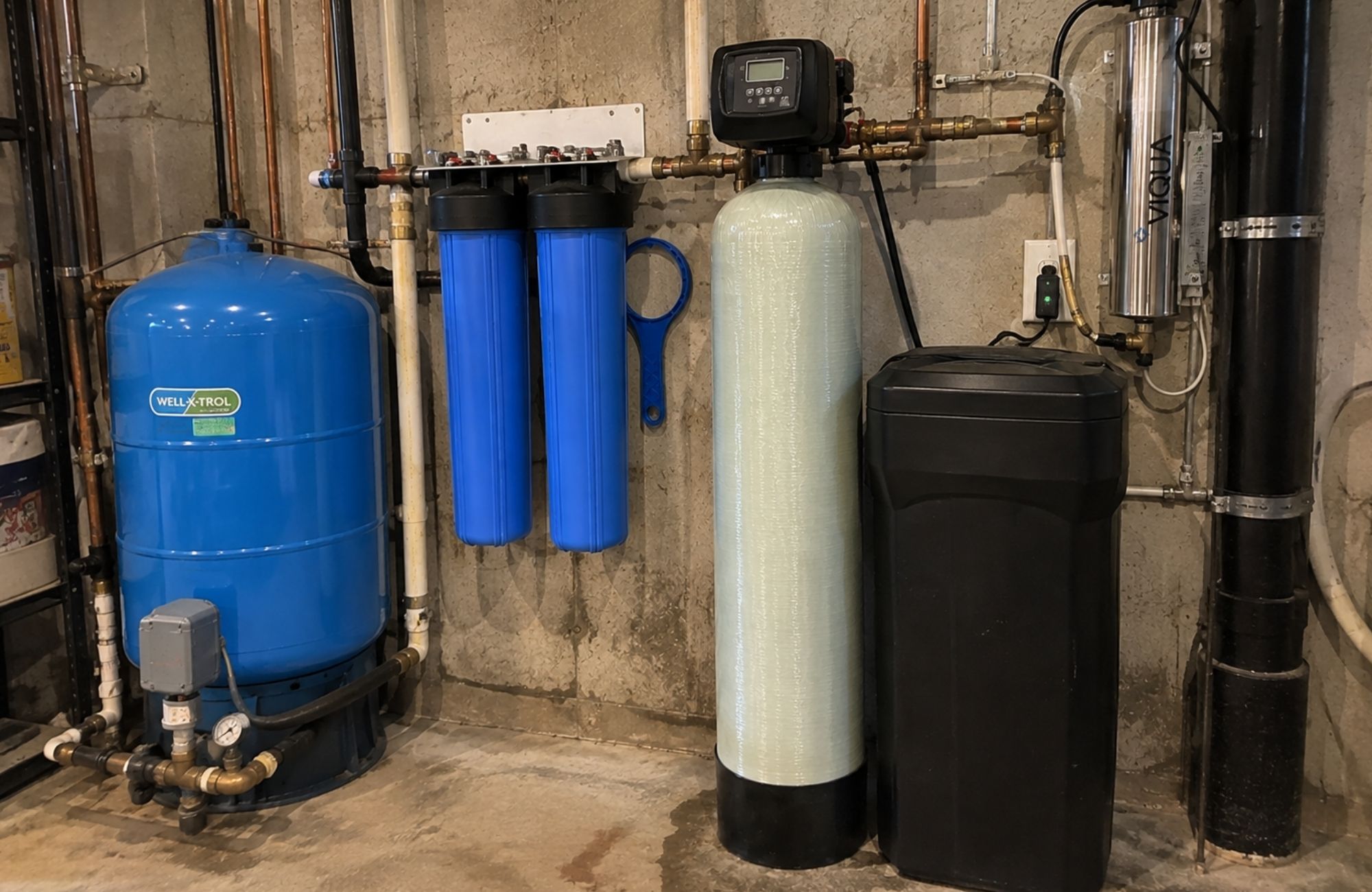
The right well water treatment options depend on what is actually in your water. A sediment filter, water softener, reverse osmosis system, activated carbon filter, and UV unit all perform different jobs. For Connecticut homeowners with private wells, choosing equipment should start with testing rather than guessing from the way the water looks, smells, or tastes.
That matters because several water problems can produce similar symptoms. A rotten egg smell may suggest a sulfur-related issue, while orange staining often raises questions about iron, but neither symptom confirms what is happening in the well. Housatonic Valley Well Pump Services helps homeowners evaluate well-water concerns based on test results, household demand, plumbing conditions, and the overall well system.
Start With a Water Test Before Choosing Well Water Treatment Options
The best well water treatment options are selected after testing shows which contaminants or water conditions need attention. Taste, odor, staining, scale, and cloudiness can point you toward the right tests, but they do not provide a diagnosis by themselves. Laboratory results give you a much better basis for deciding what type of treatment is actually needed.
Private well water can change over time. Groundwater conditions, flooding, work on the well or pump, plumbing changes, and nearby land activity can all affect water quality. Even when the water appears clear and tastes normal, testing can reveal problems that are not visible.
The CDC recommends testing private well water at least once a year for several basic indicators and checking for contaminants that may be common in the local area. It also explains that no single home treatment method protects against every water problem. That is one of the most useful principles to keep in mind before buying any filtration system.
Why Water Symptoms Are Only Clues
Orange or reddish stains may be associated with iron, while darker staining can involve manganese. A rotten egg odor may be related to hydrogen sulfide, sulfur bacteria, plumbing conditions, or another source. White scale around fixtures commonly points toward hard water, but testing is still the better way to confirm the cause.
Symptoms are most useful as a starting point. They help narrow down what should be tested, but they should not determine the treatment system on their own. Two Connecticut homes with similar-looking water may have different chemistry and need different equipment.
What a Water Test Can Tell You
A useful laboratory test can help identify bacteria, pH, hardness, iron, manganese, nitrates, arsenic, and other water-quality concerns depending on the testing panel selected. If you are dealing with a specific symptom, such as staining or odor, additional parameters may also be appropriate.
Once those results are available, treatment becomes much more straightforward. Instead of asking which filter is “best,” you can ask which treatment method addresses the contaminant found in your water and whether it needs to treat one faucet or the entire house.
Which Well Water Treatment Option Treats What?
Well water treatment systems are not interchangeable. Sediment filtration removes suspended particles, water softeners address hardness minerals, activated carbon can reduce certain tastes and chemicals, reverse osmosis treats many dissolved contaminants, and UV systems are used for microbial treatment. A home may need one of these technologies or a combination of several.
Before comparing products, it helps to separate the type of problem from the type of equipment. A whole-house filter, for example, tells you where the water is treated. It does not tell you which contaminants the filter media can remove.
The table below gives a practical overview of the most common options.
| Treatment option | Common purpose | Main limitation |
| Sediment filter | Sand, silt, rust, and suspended particles | Does not remove most dissolved contaminants |
| Water softener | Calcium and magnesium hardness | Does not disinfect water |
| Activated carbon | Certain tastes, odors, organic compounds, and chemicals | Does not remove every contaminant |
| Reverse osmosis | Many dissolved contaminants, depending on the membrane | Often needs pretreatment |
| UV treatment | Bacteria, viruses, and other microorganisms | Does not remove dissolved chemicals |
| Iron or manganese treatment | Iron, manganese, staining, and related problems | Must match the water chemistry |
| Chlorination | Microbial treatment and some sulfur-related problems | Requires proper dosing and contact time |
Sediment Filters for Sand, Silt, and Rust
Sediment filters are designed to catch physical particles before they travel through the plumbing or reach other treatment equipment. They may be useful when water contains sand, silt, rust, or visible debris. Because these filters remove suspended material rather than dissolved contaminants, clearer-looking water does not necessarily mean every water-quality problem has been addressed.
Sediment filtration is also commonly used as a protective first stage. Removing larger particles can help reduce fouling in carbon filters, UV systems, reverse osmosis equipment, and other treatment components installed farther downstream.
Water Softeners for Hard Water and Scale
Water softeners use ion exchange to reduce calcium and magnesium, the minerals responsible for most hard-water problems. Homeowners often notice hardness through scale around faucets, spots on fixtures, or buildup inside plumbing and water-using appliances. Softening can address those conditions when testing confirms that hardness is the issue.
A softener should not be treated as a complete well water filtration system. Standard softening does not disinfect the water, and it is not designed to remove every chemical or dissolved contaminant. If a water test identifies several problems, softening may be only one part of the treatment plan.
Activated Carbon for Taste, Odor, and Certain Chemicals
Activated carbon captures certain compounds on the surface of the filter media. Depending on the system, it may improve some taste and odor problems and reduce specific organic compounds or chemicals. Carbon is widely used, but its capabilities vary considerably from one filter to another.
This is where product specifications matter. A carbon filter should be selected according to the contaminant it is designed to reduce, not simply because the water has an unpleasant taste. The filter also needs proper maintenance because the media has a limited service capacity.
Reverse Osmosis for Dissolved Contaminants
Reverse osmosis, often shortened to RO, forces water through a membrane that can reduce many dissolved substances. Depending on the system and its certification, RO may be used for certain salts, heavy metals, and other dissolved contaminants in drinking water. Many residential RO systems are installed under the kitchen sink rather than treating every gallon entering the home.
Source-water conditions still matter. High sediment, hardness, iron, or other water issues can affect membrane performance and may require pretreatment. For that reason, RO is best viewed as a specific treatment technology rather than a universal answer for every well.
UV and Chlorination for Microbial Treatment
UV light and chlorination are two approaches used to disinfect well water. UV systems expose flowing water to ultraviolet light, while chlorination relies on a controlled chemical dose and enough contact time for treatment to occur. The correct method depends on the water conditions, the microbial concern, flow rate, and the way the system is designed.
Neither technology removes every type of contaminant. UV does not remove dissolved chemicals, for example, and cloudy or sediment-heavy water may interfere with treatment performance. Chlorination also needs proper setup and maintenance rather than simple chemical addition.
Common Connecticut Well Water Problems Need Different Solutions
Connecticut private wells may develop problems involving iron and manganese, hardness, sediment, hydrogen sulfide, bacteria, arsenic, or other dissolved contaminants. These problems behave differently in water and do not respond to the same filtration method. The most effective treatment plan connects the laboratory result with the water chemistry and the needs of the home.
Iron and Manganese
Iron can leave orange, reddish, or brown staining, while manganese may produce darker stains. In some homes, these minerals can also affect taste, appearance, laundry, and plumbing fixtures. The severity of the symptoms does not always tell you how much iron or manganese is present.
Treatment may involve oxidation, filtration, ion exchange, catalytic media, or another method depending on concentration and water chemistry. pH, chemical form, household flow, and other contaminants can change which system makes sense. This is another area where choosing equipment from appearance alone can lead to poor results.
Rotten Egg Odor and Hydrogen Sulfide
A rotten egg smell is commonly associated with hydrogen sulfide, but the source of the odor should still be investigated. Sulfur bacteria, plumbing conditions, and even the water heater can sometimes contribute to similar smells. If the odor occurs only in hot water or only at certain fixtures, that detail can help narrow down the source.
Treatment may include aeration, activated carbon, catalytic media, chlorination, or another approach. The better option depends on what testing finds and how much of the problem is present.
Hard Water and Scale Buildup
Hard water contains elevated calcium and magnesium. Over time, these minerals can contribute to white scale on fixtures and buildup in plumbing or water-using equipment. Some homeowners also notice that soap does not lather as easily as expected.
A water softener system can reduce hardness through ion exchange when testing shows that softening is appropriate. The equipment should be sized for household water demand and the actual hardness level, rather than selected only by the number of people living in the home.
Arsenic and Other Dissolved Contaminants
Some well-water contaminants give you no obvious warning. Arsenic, for example, cannot be reliably identified by taste, smell, or appearance. That is why laboratory testing remains part of responsible private-well ownership even when the water seems normal.
Depending on the contaminant, treatment may involve reverse osmosis, adsorption media, ion exchange, or another targeted technology. Water chemistry can influence how well those methods work, so the contaminant name alone is not enough to select or size a system.
Point-of-Entry vs. Point-of-Use Water Treatment
Point-of-entry systems treat water as it enters the home, while point-of-use systems treat water at a specific location. The right choice depends on where treatment is needed, how the contaminant affects the household, and whether the problem involves plumbing, appliances, bathing water, or mainly drinking and cooking water.
A homeowner does not always have to choose one or the other. Some properties use whole-house treatment for one water problem and a separate point-of-use system for drinking water. That can make more sense than forcing one piece of equipment to solve several unrelated issues.
When Whole-House Treatment Makes Sense
Point-of-entry treatment is often useful when a problem affects water throughout the home. Hardness, sediment, iron, manganese, and some odor problems can affect fixtures, plumbing, appliances, showers, laundry, and other water uses. Treating those conditions after the water has already entered the plumbing would offer limited benefit.
The phrase “whole-house filter” can be misleading if it is treated as a performance claim. It describes where the water is treated, not which contaminants are removed. The media inside the system still needs to match the water test.
When Point-of-Use Treatment Makes Sense
Point-of-use systems treat water at a particular faucet or fixture. They are often considered when the main concern involves drinking and cooking water rather than every gallon used throughout the home. An under-sink reverse osmosis system is a familiar example.
In some homes, the two approaches work together. Whole-house treatment may handle hardness or iron while a separate drinking-water system targets a dissolved contaminant at the kitchen sink. Housatonic Valley’s water filtration and treatment services can help homeowners determine whether point-of-entry, point-of-use, or combined treatment fits the water test and the property.
Why Some Well Water Systems Need Multiple Treatment Stages
A private well can have more than one water-quality issue at the same time. Treatment equipment can also depend on water being conditioned before it reaches the next stage. When several technologies are installed in a planned sequence, the setup is often called a treatment train.
The goal is not to install as much equipment as possible. A properly planned system uses the stages needed for the identified problems and puts them in an order that allows each component to work as intended.
What Is a Treatment Train?
A treatment train is simply a series of treatment steps, each with a specific job. Sediment might be removed first, followed by treatment for iron or hardness, with UV disinfection installed later in the sequence. A separate point-of-use RO system could then be added if the drinking-water test shows a contaminant that calls for it.
Not every property needs this kind of setup. A single treatment method may be enough when testing finds one clearly defined problem and the rest of the water chemistry is suitable.
Why Treatment Order Matters
Treatment order can affect both performance and equipment life. Heavy sediment can load filters quickly, interfere with UV treatment, or contribute to fouling in other equipment. Hardness, iron, and manganese can also affect certain treatment processes if they are not handled at the right stage.
A typical treatment sequence may involve:
- Removing sediment and larger particles.
- Correcting water conditions that could interfere with later equipment.
- Treating hardness, iron, manganese, sulfur, or another whole-house problem.
- Adding contaminant-specific drinking-water treatment where needed.
- Using disinfection when testing and system conditions call for it.
The final setup also depends on well yield, household demand, water flow, pressure, plumbing layout, backwash requirements, and manufacturer specifications. Those factors are easy to overlook when comparing equipment online.
What Affects the Cost of a Well Water Treatment System?
There is no single useful price for a well water treatment system because the scope can range from a basic sediment filter to a multi-stage whole-house setup. Water-test results, treatment technology, capacity, flow requirements, plumbing changes, installation conditions, and future maintenance all affect cost. Comparing systems only by purchase price can leave out a large part of the decision.
The Water Problem Changes the Equipment Needed
A home dealing only with sediment will usually require a much simpler setup than a property with iron, hardness, sulfur odor, and a separate drinking-water contaminant. The test results determine how many treatment steps are justified and what type of media or equipment should be considered.
This is one reason testing can save money as well as improve treatment decisions. It reduces the chance of buying a general-purpose filter that does little for the problem actually present.
Flow Rate and Household Demand Matter
Whole-house treatment has to keep up with the amount of water the home may use during busy periods. If the equipment is undersized, residents may notice pressure or flow problems, and some treatment processes may not perform as intended.
Sizing can depend on household demand, number of fixtures, pump performance, pressure-tank conditions, well yield, and the type of treatment being used. Two homes with the same contaminant level can still require different equipment sizes.
Maintenance Is Part of the Long-Term Cost
Every treatment system has maintenance needs. Sediment cartridges fill with debris, carbon media eventually loses capacity, UV lamps need servicing, RO filters and membranes require replacement, and softeners need the proper regenerant. The timing varies with the equipment, water use, and contaminant load.
Ask about those requirements before comparing quotes. A cheaper system can become more expensive over time if it uses costly replacement parts, wastes water, or needs frequent service.
How to Choose a Well Water Treatment System in Connecticut
Choosing well water treatment is easier when the decision follows a logical order. Start with laboratory results, identify the specific problem, match the equipment to that problem, check whether it can handle the home’s flow and demand, and understand how it will be maintained. Connecticut licensing requirements should also be considered when the work involves domestic water pumps or water-conditioning systems.
Begin With Laboratory Results
Keep a copy of your water test and use the actual results when discussing treatment. Concentrations matter because the same contaminant may require a different system depending on how much is present. The rest of the water chemistry may also affect the recommendation.
If testing identifies a contaminant associated with health concerns, follow guidance from the laboratory or appropriate public-health authority about water use. Treatment should be followed by any testing needed to confirm that the system is working as intended.
Match the Equipment to the Actual Problem
Look for a system designed for the contaminant shown in the test results. A sediment filter should not be expected to remove arsenic, and a water softener should not be treated as a disinfection system. Similar-looking filters may also contain different media and have very different treatment capabilities.
Manufacturer documentation and applicable product certifications can help clarify what a system is designed to reduce. That information should be considered alongside the home’s water chemistry and flow requirements.
Check Sizing, Plumbing, and Maintenance Needs
Treatment equipment has to work with the rest of the well system. Water flow, pressure, pump performance, household demand, plumbing layout, and available drain capacity can all affect the installation.
Maintenance should be discussed at the same time as equipment selection. Homeowners should know what needs to be changed or serviced, how often maintenance is likely to be required, and whether ignoring that maintenance could affect treatment performance.
Work With a Properly Licensed Connecticut Contractor
Water-conditioning work in Connecticut is regulated, so contractor qualifications matter. A Connecticut J-1 Limited Contractor license covers work involving domestic water pumps and water conditioning. Homeowners should verify that the contractor they hire holds the appropriate license for the work being performed.
That background is useful when a water-quality problem may be connected to more than filtration alone. Pump performance, pressure conditions, plumbing, and the physical well system can all influence the final solution. Homeowners who need a broader system review can also use Housatonic Valley’s well inspection services.
Choose Well Water Treatment Based on What Your Water Actually Needs
The right well water treatment depends on the contaminants present, the home’s water demand, and the condition of the overall well system. Some properties may need one treatment method, while others may require several stages working together.
Housatonic Valley Well Pump Services helps homeowners in Litchfield County and Upper Fairfield County evaluate well water treatment options based on water-test results and the condition of the overall well system. Contact us to discuss water filtration, treatment, or related well-system service.
FAQs
What Is the Most Effective Treatment System for Well Water?
The most effective treatment system is the one matched to the contaminants found in your water. A softener may be appropriate for hardness, UV may be used for microbial treatment, and reverse osmosis may reduce certain dissolved contaminants. If testing finds several separate problems, the right solution may involve multiple treatment stages rather than one filter.
What Is the Most Common Contaminant in Well Water?
There is no single contaminant that can accurately be called the most common in every private well. Iron, manganese, bacteria, hardness minerals, nitrates, arsenic, sediment, and other contaminants vary with geology, well construction, land use, and local groundwater conditions. Testing your own well is more useful than assuming your water matches a regional average.
How Much Does a Well Water Treatment System Cost?
Cost depends on the contaminant, treatment method, system capacity, household flow requirements, plumbing conditions, installation needs, and maintenance. A small point-of-use drinking-water system is a very different project from a multi-stage whole-house system. A site-specific quote based on testing and system conditions gives a homeowner a more useful number than a broad national average.
How Often Does Well Water Need to Be Treated?
Installed treatment equipment normally works as water passes through it, so well water is not usually “treated” on a fixed calendar schedule. The system itself does need regular maintenance based on water use, contaminant load, equipment design, and manufacturer instructions. Private wells should also be tested periodically because water quality can change even when the system appears to be working normally.
Should I Test My Well Water Before Buying a Filtration System?
Yes. Testing identifies the contaminants or water conditions that actually need attention and helps narrow down the treatment technologies that make sense. It also reduces the risk of spending money on equipment that improves a symptom without addressing the underlying water problem.
Do I Need a Whole-House Filter or a Point-of-Use System?
That depends on where the problem needs to be treated. Whole-house systems are generally used when water quality affects plumbing, appliances, fixtures, bathing, laundry, or other water use throughout the property. Point-of-use systems treat a specific faucet, and some homes use both approaches when whole-house and drinking-water concerns are different.