


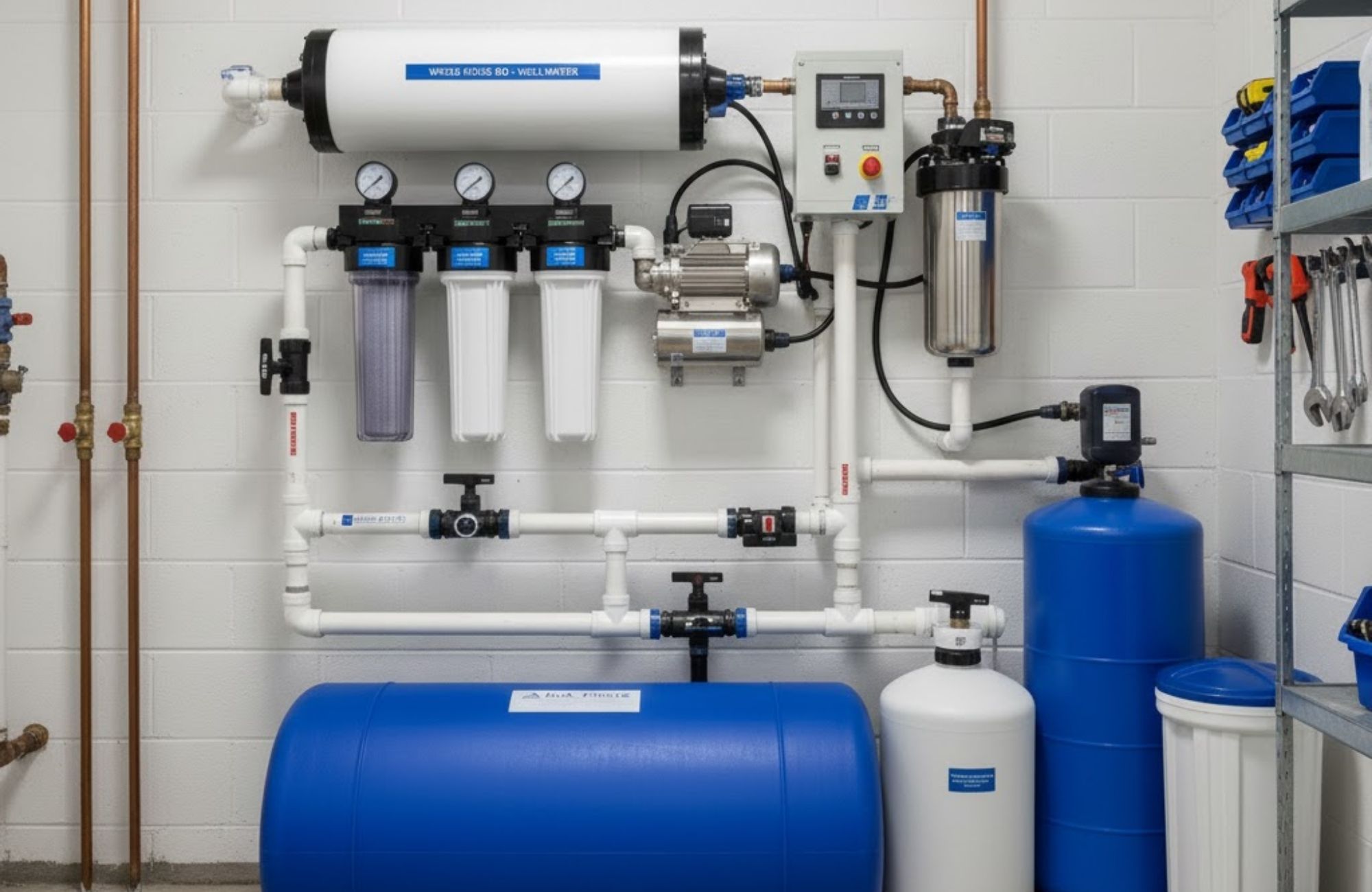
If you rely on well water for your home in New Milford, CT or nearby areas, water quality is not just a preference. It affects your health, your plumbing, and your daily life. Many homeowners dealing with arsenic, high total dissolved solids, or other harmful contaminants eventually come across one option that sounds like the ultimate fix: whole house reverse osmosis for well water.
A whole house reverse osmosis system can produce extremely pure water, but it is also one of the most complex and expensive water treatment options available for residential wells. In many cases, it is not the best or most practical solution. This guide explains how whole house reverse osmosis works with well water, when it makes sense, when it does not, and what Connecticut homeowners should do before investing in one.
If you are considering a whole house RO system or simply want clear answers about your well water in New Milford, Danbury, Brookfield, or surrounding Litchfield County towns, you can schedule a professional water test and system evaluation with Housatonic Valley Well Pump Services to get honest, test-based recommendations.
What Is a Whole House Reverse Osmosis System for Well Water
A whole house reverse osmosis system for well water is a point-of-entry water treatment system that filters all water entering a home through a reverse osmosis membrane. This membrane removes dissolved contaminants that many standard filtration systems cannot, producing highly purified water throughout the entire house.
Reverse osmosis works differently from typical filters. Instead of trapping particles like sediment or iron, the reverse osmosis membrane removes dissolved substances at the molecular level. This includes contaminants such as arsenic, nitrates, sodium, and other harmful chemicals that may be present in well water.
Unlike under-sink RO units that treat only drinking water, a whole house RO system treats water for every faucet, shower, appliance, and fixture in the home. While this provides consistent water quality everywhere, it also introduces challenges related to flow rate, storage, water pressure, and wastewater management.
How Whole House Reverse Osmosis Works on a Well System
A whole house RO system connected to a well water supply is not a single filter. It is a multi-stage water treatment process designed to protect the membrane, maintain pressure, and deliver treated water reliably throughout the home.
At a high level, the system pulls feed water from the well, treats it in stages, stores purified water, and then distributes that water through the plumbing system using pumps. Because wells do not have the constant pressure of municipal water, proper system design is critical.
What a Typical Whole House Reverse Osmosis Setup for Well Water Includes
- Pre-treatment filtration, such as sediment filters, iron filters, or a water softener, to protect the RO membrane from fouling and damage
- A reverse osmosis membrane that removes dissolved contaminants, heavy metals, and harmful chemicals
- A large storage tank, often holding hundreds of gallons, because RO filtration is slow by design
- A booster pump or demand pump to maintain water pressure and flow rate throughout the home
- Post-treatment components, such as a UV system for bacteria and coliform protection or pH correction for acidic water
Without proper pre-treatment and pump sizing, a whole house RO system can suffer from low water pressure, excessive wastewater production, and shortened membrane life. This is why professional evaluation of the well pump, pressure tank, and water chemistry is essential before installation.
When a Whole House Reverse Osmosis System Makes Sense for Well Water
Whole house reverse osmosis is not a general-purpose filtration solution. It is best reserved for specific water quality problems that cannot be solved by standard water treatment systems. For well water, whole house RO may be appropriate when laboratory testing confirms serious dissolved contaminant issues, such as arsenic or nitrates, that exceed safe drinking water standards. These contaminants cannot be reliably removed by carbon filters, iron filters, or softeners alone.
Situations where Whole House Reverse Osmosis may Make Sense
- Elevated arsenic levels confirmed by a certified water test
- High nitrates often associated with agricultural runoff
- Extremely high total dissolved solids (TDS) that affect taste, safety, and appliance performance
- Saltwater intrusion in coastal or compromised aquifers
- Industrial or environmental contamination affecting the water source
In Litchfield County, arsenic and naturally occurring minerals are common drivers for advanced treatment.
Why Whole House Reverse Osmosis Is Often Not the Best Option
While reverse osmosis produces very pure water, treating the entire home with RO is often unnecessary and inefficient for most well owners. In many cases, the downsides outweigh the benefits. Whole house reverse osmosis systems are expensive to install and maintain. They require significant space for tanks and equipment, produce wastewater during the filtration process, and rely on pumps to maintain usable water pressure. Without careful design, homeowners may experience slow flow rates or inconsistent pressure.
Common Drawbacks of Whole House Reverse Osmosis
- High upfront cost compared to other water treatment systems
- Ongoing membrane replacement and maintenance expenses
- Wastewater production, which can strain septic systems
- Large equipment footprint requiring dedicated space
- Removal of beneficial minerals, requiring post-treatment blending or remineralization
For many homeowners in Danbury, Brookfield, and Southbury, these challenges make whole house RO an extreme solution when a more targeted approach would provide better overall quality and reliability.
Whole House RO vs Smarter Hybrid Systems for Well Water
In most homes, the best solution is not an all-or-nothing approach. Instead of treating every gallon of water with reverse osmosis, many well systems perform better with a hybrid setup that targets specific problems.
A common and effective configuration includes whole-house filtration for common contaminants, combined with a point-of-use RO system for drinking water. This approach improves overall water quality while avoiding the drawbacks of full-home RO.
A typical hybrid system may include:
- Whole-house sediment and iron filtration
- A water softener if hardness is present
- UV disinfection for bacteria and E. coli protection
- An under-sink reverse osmosis system for drinking and cooking water
This setup provides safe, great-tasting drinking water while preserving water pressure, reducing wastewater, and lowering long-term costs. Housatonic Valley Well Pump Services frequently recommends hybrid systems after reviewing a homeowner’s water report and well system design.
If you are unsure which approach fits your home, a professional evaluation can determine whether whole house reverse osmosis is truly necessary or if a hybrid system offers better performance and value.
What’s Required to Install Whole House Reverse Osmosis on a Well
Installing a whole house reverse osmosis system on a well involves more than adding a filter. The entire water system must support the filtration process and household demand.
Before installation, several factors must be evaluated carefully
- Water test results identifying contaminants and water chemistry
- Well pump capacity and sustained flow rate
- Pressure tank size and condition
- Space for a large storage tank and treatment equipment
- Drainage for wastewater discharge
- Electrical supply for booster pumps and UV systems
Ignoring these requirements can result in poor performance and costly adjustments later. Housatonic Valley Well Pump Services evaluates the well pump, pressure tank, and filtration needs together, ensuring the system delivers reliable treated water without sacrificing pressure or efficiency.
Cost of a Whole House Reverse Osmosis System for Well Water
Whole house reverse osmosis systems represent one of the highest investments in residential water treatment. Costs vary widely based on system size, pretreatment needs, and installation complexity.
Typical cost considerations include
- RO membranes, tanks, pumps, and filtration components
- Installation labor and plumbing modifications
- Electrical work for pumps and UV systems
- Ongoing maintenance, membrane replacement, and water usage
While some homeowners assume RO will replace bottled water costs, whole house systems are rarely justified for taste alone. For most families, the decision should be driven by documented health risks identified through professional water testing.
Professional Water Testing Comes First
No homeowner should invest in a whole house reverse osmosis system without accurate water testing. A certified water test identifies exactly which contaminants are present and at what levels, allowing the system to be designed correctly from the start.
Water testing also prevents unnecessary equipment purchases. Many homes that initially consider whole house RO ultimately achieve better results with targeted filtration, softening, or UV treatment once the true water chemistry is understood.
Conclusion
Whole house reverse osmosis for well water can be an effective solution in specific situations, but it is rarely the first or best option for most homeowners. The right system starts with understanding your water source, testing for contaminants, and designing a treatment plan that fits your well, your home, and your long-term needs.
If you rely on well water in New Milford, Danbury, Brookfield, or surrounding Connecticut towns, reach out to Housatonic Valley Well Pump Services today. Schedule a water test and system evaluation to receive clear answers and upfront pricing, with a solution tailored specifically to your water needs.
FAQs
Can you use a reverse osmosis system with well water?
Yes, reverse osmosis systems can be used with well water, but proper pretreatment is critical. Sediment, iron, hardness, and bacteria must be addressed before water reaches the RO membrane to prevent damage and performance issues. A professional water test helps determine whether a whole house or point-of-use RO system is appropriate.
Is reverse osmosis worth it for well water?
Reverse osmosis is worth it for well water only when testing confirms serious dissolved contaminants such as arsenic, nitrates, or extremely high TDS. For many homeowners, a hybrid system with whole-house filtration and under-sink RO provides safer water at a lower cost. The best approach depends on water quality results and household needs.
What is the best whole home water filtration system for well water?
The best whole home water filtration system for well water depends on the contaminants present. Common systems include sediment filtration, iron removal, water softeners, and UV disinfection. Reverse osmosis is typically added only when dissolved contaminants cannot be addressed through other treatment methods.
Can well water have a whole house filter?
Yes, well water can and often should have a whole house filter. Whole house filtration protects plumbing, appliances, and water quality throughout the home. The specific filter types should be selected based on a professional water test rather than a generic system.